
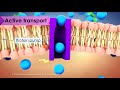
Cell Transport Mechanisms: Passive Versus Active Explained

Interactive Video
•
Biology, Science, Chemistry
•
9th - 10th Grade
•
Practice Problem
•
Hard

Patricia Brown
FREE Resource
Read more
6 questions
Show all answers
1.
MULTIPLE CHOICE QUESTION
30 sec • 1 pt
What is the main characteristic of passive transport?
It occurs automatically without energy.
It moves particles from low to high concentration.
It requires energy input.
It involves protein pumps.
2.
MULTIPLE CHOICE QUESTION
30 sec • 1 pt
Which process is an example of passive transport?
Osmosis
Diffusion
Endocytosis
Exocytosis
3.
MULTIPLE CHOICE QUESTION
30 sec • 1 pt
What is required for active transport to occur?
No energy
Energy input
High concentration gradient
Low concentration gradient
4.
MULTIPLE CHOICE QUESTION
30 sec • 1 pt
In active transport, particles move from:
Inside to outside the cell
Low to high concentration
Outside to inside the cell
High to low concentration
5.
MULTIPLE CHOICE QUESTION
30 sec • 1 pt
Why is active transport important in heart muscle cells?
To produce oxygen
To store energy
To allow the heart to beat
To maintain a constant temperature
6.
MULTIPLE CHOICE QUESTION
30 sec • 1 pt
What is the key difference between passive and active transport?
Neither requires energy.
Passive transport requires energy, active does not.
Both require energy.
Active transport requires energy, passive does not.
Access all questions and much more by creating a free account
Create resources
Host any resource
Get auto-graded reports

Continue with Google

Continue with Email

Continue with Classlink

Continue with Clever
or continue with

Microsoft
%20(1).png)
Apple

Others
Already have an account?


