Explore Wayground's free printable worksheets and practice problems on Properties of Matter, featuring comprehensive PDF resources with answer keys to help students master the fundamental characteristics and behaviors of solids, liquids, and gases.
Properties of matter worksheets available through Wayground (formerly Quizizz) provide comprehensive coverage of fundamental chemistry concepts that form the foundation of scientific understanding. These educational resources systematically explore physical and chemical properties, states of matter, density, solubility, and phase changes through engaging practice problems and structured activities. Students develop critical thinking skills as they analyze matter at the molecular level, distinguish between extensive and intensive properties, and apply their knowledge to real-world scenarios. Each worksheet collection includes detailed answer keys to support independent learning and self-assessment, while the free printable pdf format ensures accessibility for diverse learning environments. These carefully crafted materials strengthen observational skills, scientific reasoning, and the ability to classify and predict the behavior of different substances based on their inherent characteristics.
Wayground (formerly Quizizz) empowers educators with an extensive library of millions of teacher-created resources focused on properties of matter, offering robust search and filtering capabilities that streamline lesson planning and curriculum alignment. The platform's sophisticated tools enable teachers to differentiate instruction effectively, customizing worksheets to match varying skill levels and learning objectives while maintaining alignment with educational standards. These versatile materials are available in both printable and digital formats, including downloadable pdf options, making them ideal for traditional classrooms, remote learning environments, and hybrid educational settings. Teachers can seamlessly integrate these resources into their instruction for targeted remediation, advanced enrichment opportunities, or systematic skill practice, while the comprehensive answer keys and detailed explanations support efficient grading and provide valuable feedback mechanisms that enhance student understanding of complex chemistry concepts.
FAQs
How do I teach the difference between physical and chemical properties of matter?
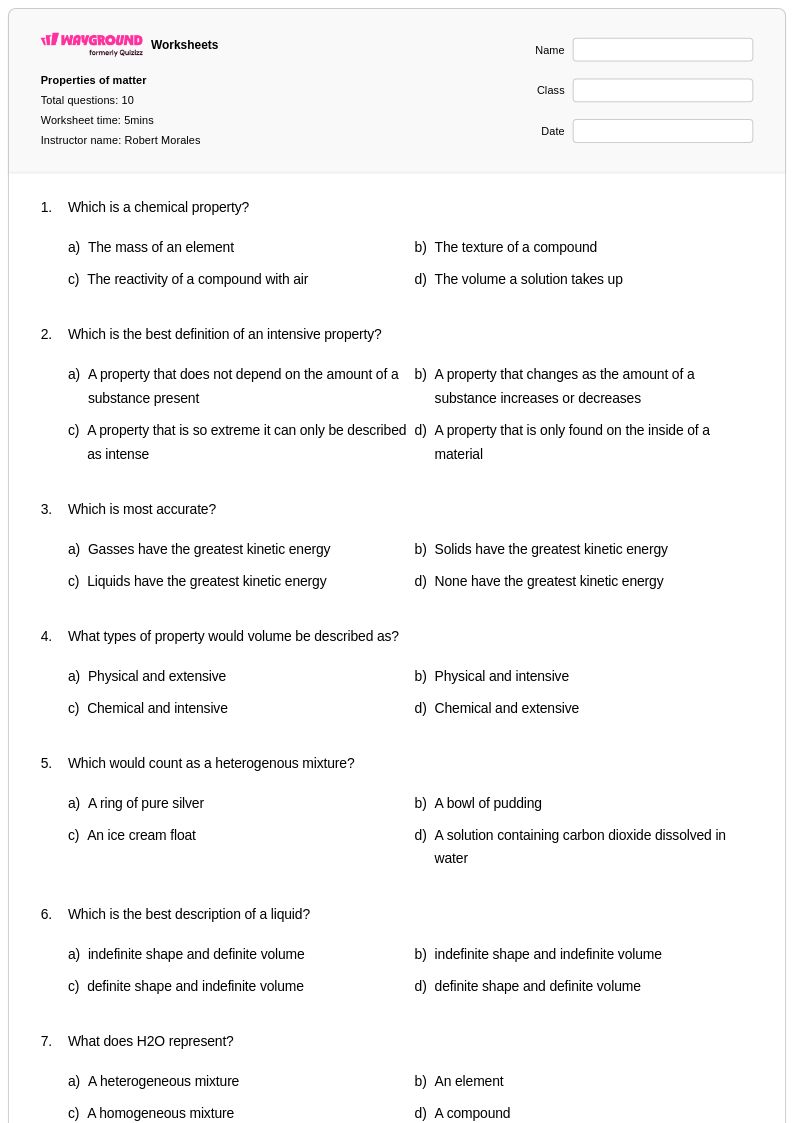
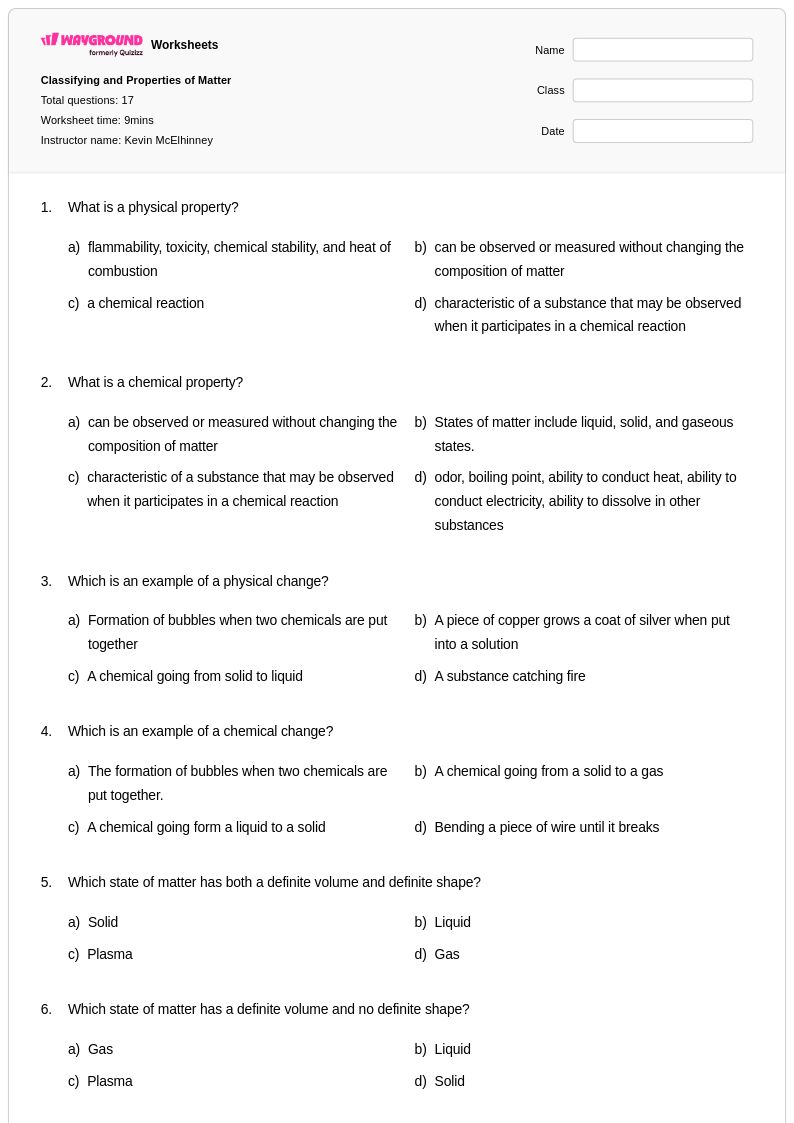
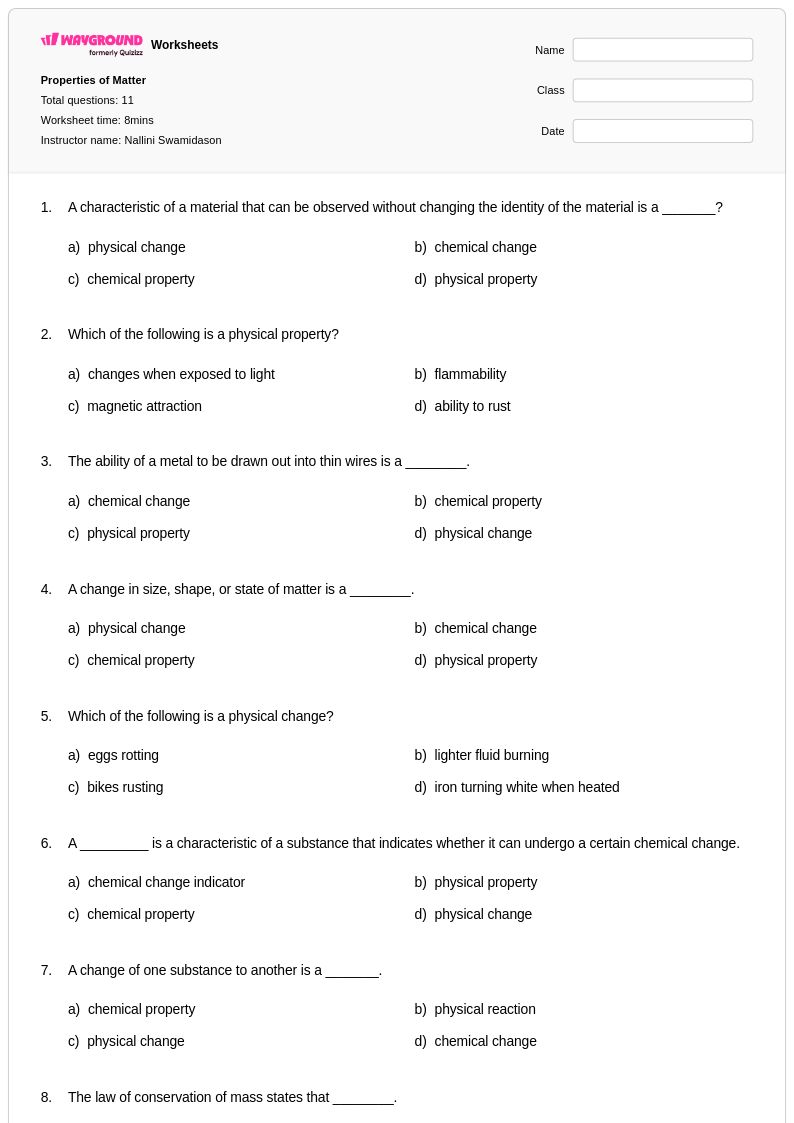
Start by anchoring students to observable evidence: physical properties (color, mass, density, solubility) can be measured without changing the substance's identity, while chemical properties (flammability, reactivity, oxidation) describe how a substance transforms into something new. Use side-by-side comparison charts so students practice sorting examples before moving to written explanations. Concrete demonstrations, like dissolving salt versus burning paper, make the distinction tangible and harder to forget.
What exercises help students practice identifying physical and chemical properties?
Classification activities work especially well: give students a list of observable events or substance descriptions and ask them to sort each as a physical or chemical property, then justify their reasoning in writing. Scenario-based problems, where students must predict how a substance will behave based on its known properties, push beyond simple recall and build applied understanding. Structured practice on distinguishing extensive properties (mass, volume) from intensive properties (density, boiling point) is also high-value, as students frequently confuse these two categories.
What mistakes do students commonly make when learning about properties of matter?
The most persistent error is conflating physical changes with chemical changes — students often assume any visible transformation (like dissolving or melting) is a chemical reaction. A related misconception is treating all intensive properties as chemical properties simply because they feel less tangible than mass or volume. Students also frequently struggle with density, applying the formula without understanding why a substance's density is constant regardless of sample size, which is worth addressing directly through multiple practice examples.
How can I differentiate properties of matter instruction for students at different skill levels?
For struggling students, reduce the complexity of answer choices and focus first on the physical vs. chemical distinction before introducing subcategories like extensive and intensive properties. Advanced students benefit from scenario-based problems that ask them to predict substance behavior or explain molecular-level reasoning. On Wayground, teachers can apply individual accommodations such as reduced answer choices or Read Aloud support for specific students, while the rest of the class works through standard settings, without drawing attention to those adjustments.
How do I use Wayground's properties of matter worksheets in my classroom?
Wayground's properties of matter worksheets are available as printable PDFs for traditional classroom use and in digital formats for technology-integrated or remote learning environments. Teachers can also host worksheets directly as a quiz on Wayground, enabling real-time student responses and built-in assessment. Each worksheet includes a complete answer key, making them practical for independent practice, guided review, or homework assignments without additional grading prep.
How do I help students understand density as a property of matter?
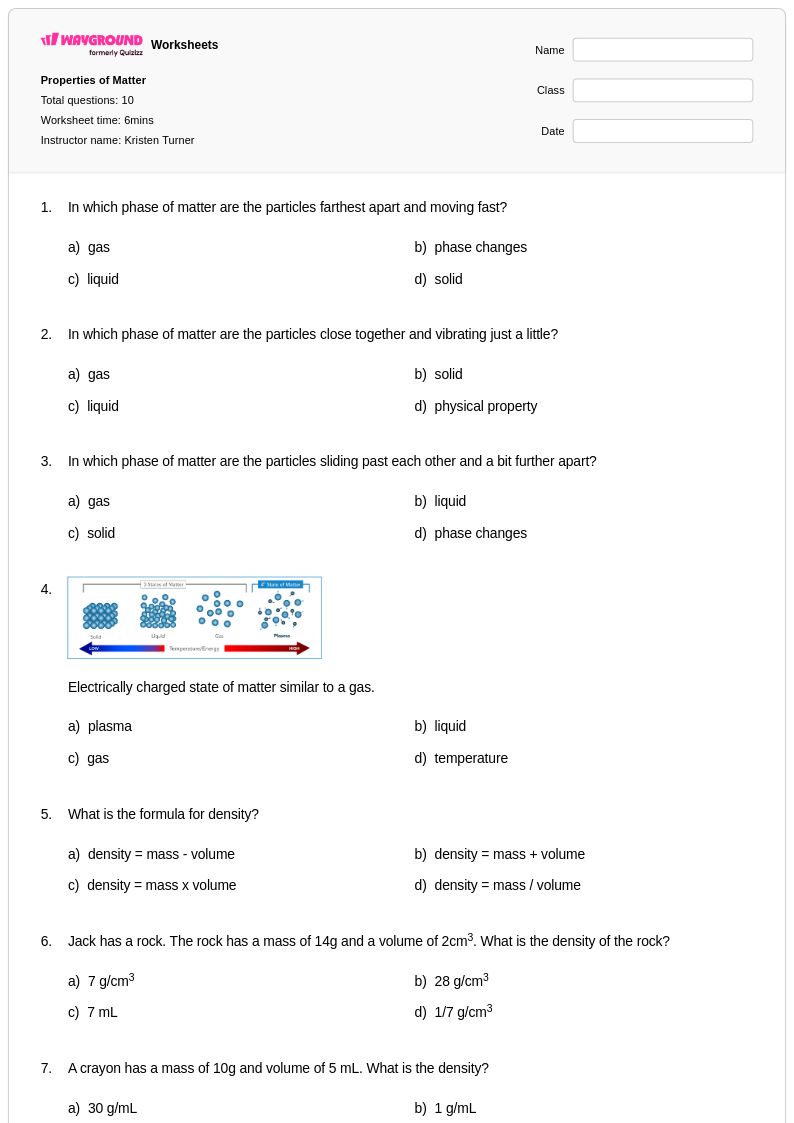
Emphasize early and often that density is an intensive property, meaning it stays the same regardless of how much of a substance you have — a key point students consistently misapply. Pair the formula (density = mass ÷ volume) with hands-on or visual examples showing that a small sample of iron and a large sample of iron have identical densities. Problems that ask students to compare densities of unknown substances and predict whether they will sink or float in water are particularly effective at cementing this concept.