Free Printable Spring Potential Energy and Hookes Law worksheets
Access Wayground's comprehensive collection of free Spring Potential Energy and Hooke's Law worksheets with printable PDFs, practice problems, and answer keys to help students master elastic force calculations and energy transformations.
Explore printable Spring Potential Energy and Hookes Law worksheets
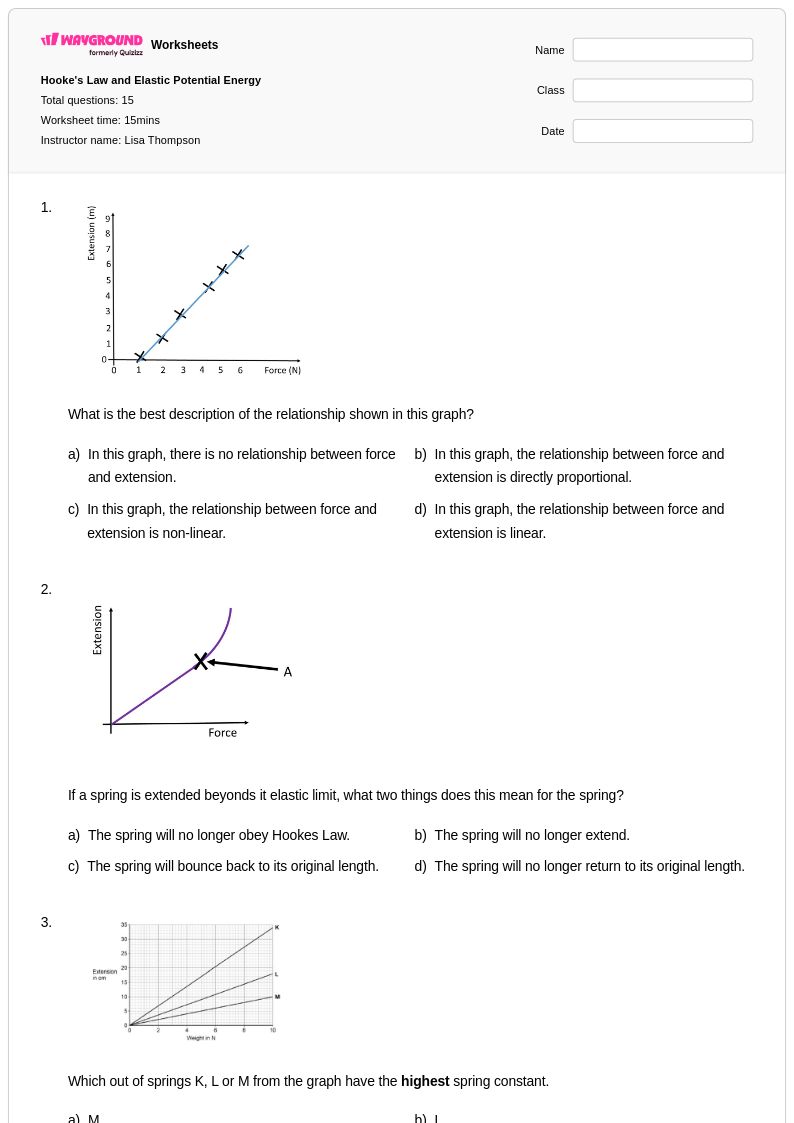
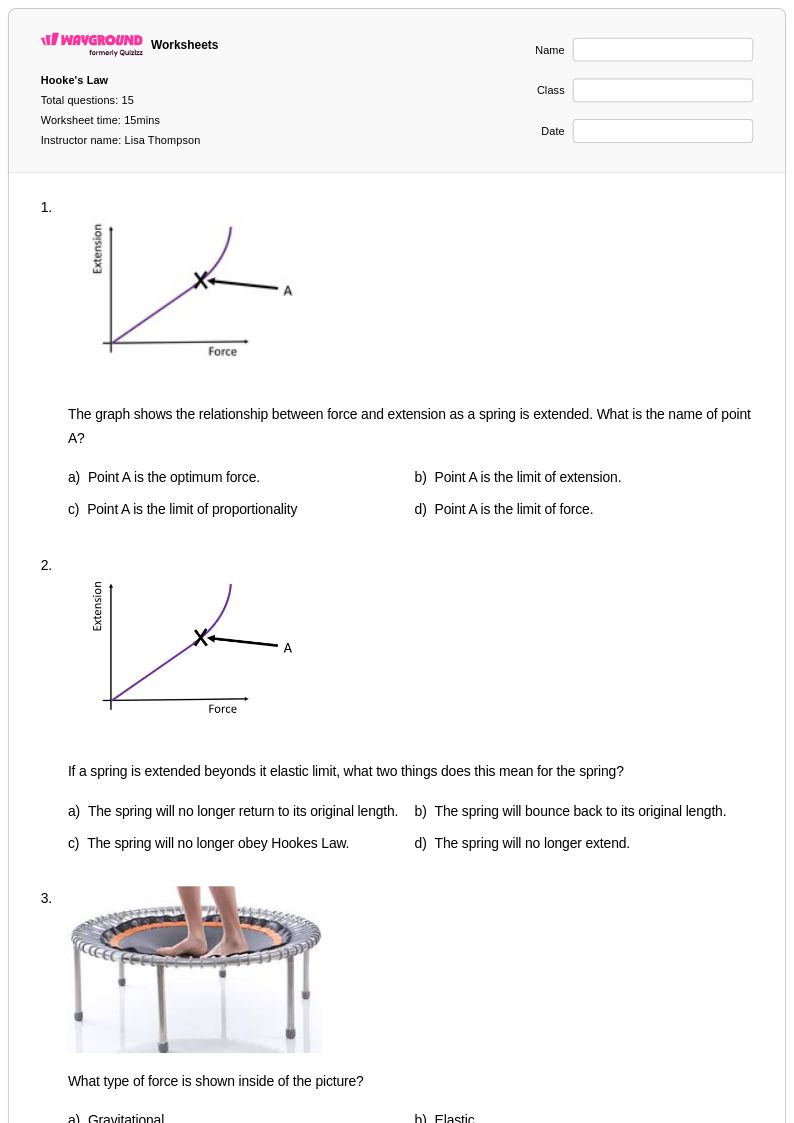
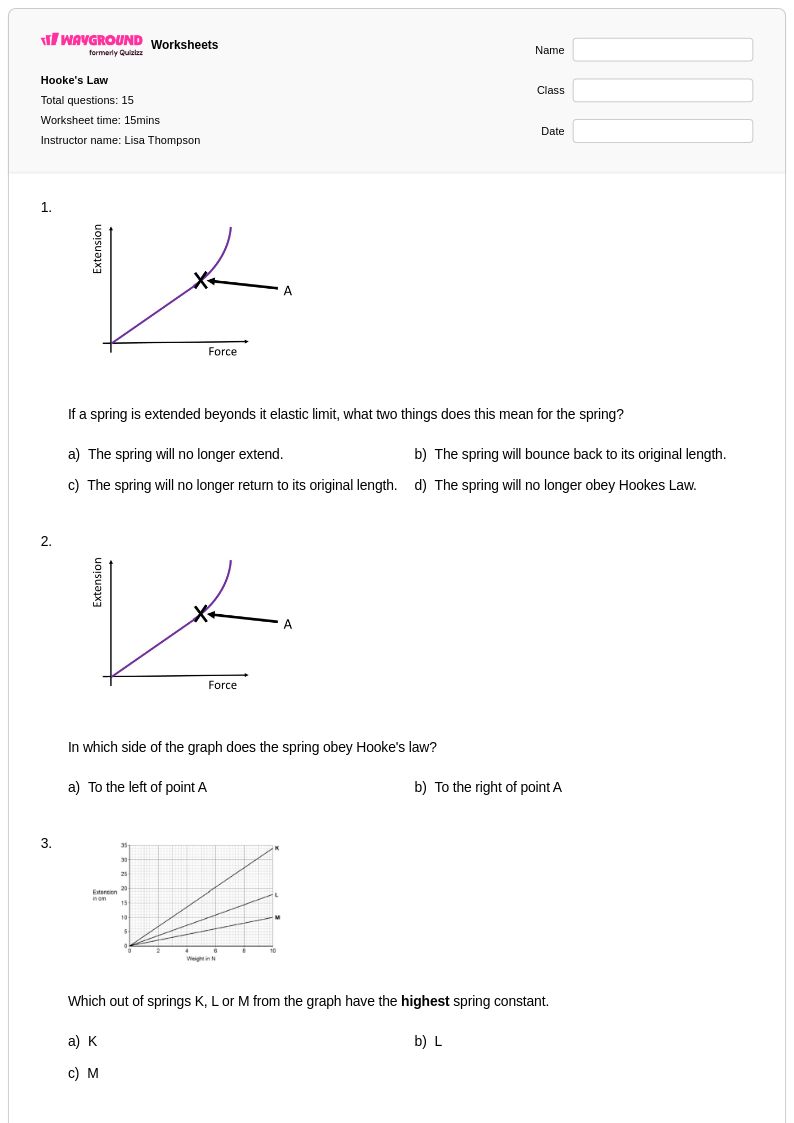
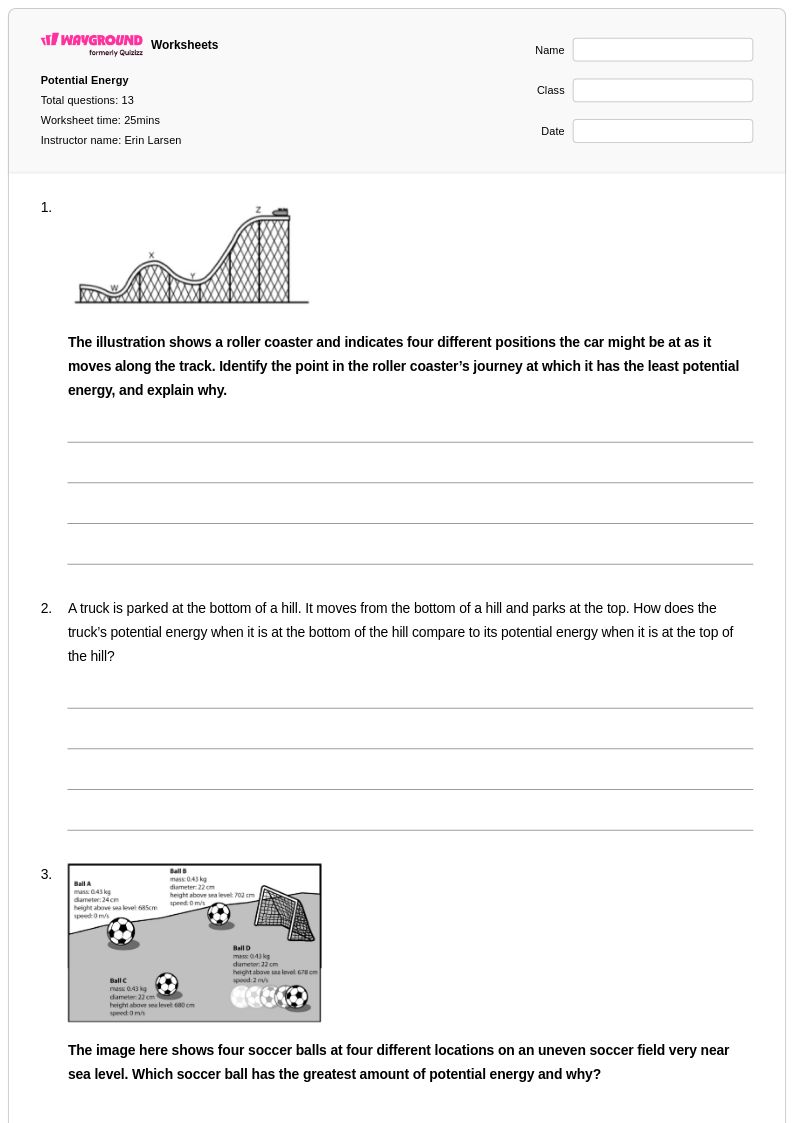
Spring potential energy and Hooke's Law worksheets available through Wayground (formerly Quizizz) provide comprehensive practice materials that help students master the fundamental relationship between elastic force and displacement in spring systems. These carefully designed worksheets guide learners through calculating spring potential energy using the formula PE = ½kx², understanding the linear relationship described by Hooke's Law (F = -kx), and analyzing real-world applications of elastic potential energy in mechanical systems. Students develop critical problem-solving skills by working through practice problems that involve determining spring constants, calculating energy transformations between kinetic and potential energy, and interpreting force-displacement graphs. Each worksheet collection includes detailed answer keys and is available as free printable PDFs, enabling students to work through complex physics concepts at their own pace while building confidence in energy conservation principles and elastic mechanics.
Wayground (formerly Quizizz) empowers educators with access to millions of teacher-created spring potential energy and Hooke's Law resources that streamline lesson planning and enhance student understanding of elastic systems. The platform's robust search and filtering capabilities allow teachers to quickly locate worksheets aligned with specific physics standards and learning objectives, while built-in differentiation tools enable customization for students with varying skill levels and learning needs. Teachers can seamlessly adapt these materials for remediation sessions with struggling learners, enrichment activities for advanced students, or regular skill practice across diverse classroom settings. The flexible format options, including both printable and digital PDF versions, support various instructional approaches from traditional paper-based assignments to technology-integrated lessons, ensuring that every educator can effectively incorporate spring mechanics and energy concepts into their physics curriculum regardless of their classroom environment or teaching style.
FAQs
How do I teach Hooke's Law and spring potential energy to physics students?
Start by establishing the linear relationship between force and displacement using Hooke's Law (F = -kx) before introducing spring potential energy (PE = ½kx²). Hands-on demonstrations with physical springs and masses help students visualize how displacement affects both restoring force and stored energy. Once students can interpret force-displacement graphs, transition to quantitative problem-solving involving spring constants and energy transformations between kinetic and potential energy.
What practice problems help students master spring potential energy calculations?
Effective practice problems ask students to calculate spring potential energy using PE = ½kx², determine unknown spring constants from given force and displacement values, and analyze energy conservation as a spring system transitions between kinetic and potential energy. Problems that incorporate force-displacement graphs strengthen conceptual understanding alongside algebraic fluency. Scaffolded problem sets that increase in complexity allow students to build confidence before tackling multi-step energy transformation scenarios.
What mistakes do students commonly make when applying Hooke's Law?
A frequent error is confusing the spring constant k with the applied force, leading students to misidentify which quantity is being solved for. Students also commonly forget to square the displacement when calculating PE = ½kx², or they drop the negative sign in F = -kx without understanding it indicates the force opposes displacement. Another misconception is treating spring potential energy and gravitational potential energy as interchangeable rather than as distinct forms of stored energy that must be tracked separately in conservation problems.
How do students often misunderstand force-displacement graphs in spring problems?
Students frequently misread the slope of a force-displacement graph, not recognizing that slope equals the spring constant k. They may also confuse the area under the graph, which represents work done or elastic potential energy stored, with the slope itself. Targeted practice interpreting these graphs alongside calculation problems helps correct both errors and deepens students' understanding of the linear relationship Hooke's Law describes.
How can I use Wayground's Spring Potential Energy and Hooke's Law worksheets in my classroom?
Wayground's Spring Potential Energy and Hooke's Law worksheets are available as free printable PDFs for traditional paper-based assignments and in digital formats for technology-integrated instruction, including the ability to host them as a quiz on Wayground. Each worksheet includes a complete answer key, making them practical for independent practice, homework, or in-class problem-solving sessions. Teachers can also apply student-level accommodations such as extended time, read aloud, or reduced answer choices directly within the platform to support learners with varying needs.
How do I differentiate spring potential energy instruction for students at different skill levels?
For struggling students, begin with single-variable Hooke's Law problems where only one unknown needs to be isolated before progressing to energy calculations. Advanced students benefit from multi-step problems that integrate energy conservation across spring and gravitational systems. On Wayground, teachers can apply accommodations such as reduced answer choices or read aloud at the individual student level, allowing the same worksheet to serve the full range of learners in one class without disrupting peers.