
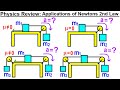
Understanding Newton's Second Law and System Acceleration

Interactive Video
•
Physics
•
9th - 10th Grade
•
Hard

Evelyn Hayes
FREE Resource
5 questions
Show all answers
1.
MULTIPLE CHOICE QUESTION
30 sec • 1 pt
What is the primary focus when analyzing a system using Newton's Second Law?
The color of the objects in the system
Forces acting on the system as a whole
The temperature of the environment
Internal forces within the system
2.
MULTIPLE CHOICE QUESTION
30 sec • 1 pt
When considering friction in a system, in which direction does it typically act?
In a random direction
Perpendicular to the system's motion
Opposite to the assumed motion of the system
In the same direction as the system's motion
3.
MULTIPLE CHOICE QUESTION
30 sec • 1 pt
How is the frictional force calculated in the context of Newton's Second Law?
By adding the normal force to the gravitational force
By multiplying the normal force by the coefficient of friction
By dividing the normal force by the coefficient of friction
By multiplying the normal force by the gravitational constant
4.
MULTIPLE CHOICE QUESTION
30 sec • 1 pt
In a system with friction, what must be done to find the acceleration?
Add the opposing forces to the aiding forces
Subtract the opposing forces from the aiding forces
Multiply the opposing forces by the aiding forces
Ignore the opposing forces
5.
MULTIPLE CHOICE QUESTION
30 sec • 1 pt
What is the final step in calculating the acceleration of a system?
Add the total mass to the net force
Divide the net force by the total mass of the system
Divide the aiding forces by the opposing forces
Multiply the total mass by the aiding forces
Access all questions and much more by creating a free account
Create resources
Host any resource
Get auto-graded reports

Continue with Google

Continue with Email

Continue with Classlink

Continue with Clever
or continue with

Microsoft
%20(1).png)
Apple

Others
Already have an account?


