
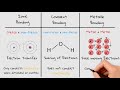
Understanding Chemical Bonding

Interactive Video
•
Chemistry
•
9th - 10th Grade
•
Hard

Evelyn Hayes
FREE Resource
10 questions
Show all answers
1.
MULTIPLE CHOICE QUESTION
30 sec • 1 pt
What is the key difference between ionic and covalent bonding?
Both ionic and covalent bonding involve transferring electrons.
Both ionic and covalent bonding involve sharing electrons.
Ionic bonding involves transferring electrons, while covalent bonding involves sharing electrons.
Ionic bonding involves sharing electrons, while covalent bonding involves transferring electrons.
2.
MULTIPLE CHOICE QUESTION
30 sec • 1 pt
Which of the following is a characteristic of ionic compounds?
They have low melting and boiling points.
They conduct electricity in solid form.
They conduct electricity when dissolved in water.
They are formed between two non-metals.
3.
MULTIPLE CHOICE QUESTION
30 sec • 1 pt
How do sodium and chlorine form an ionic bond?
Sodium shares electrons with chlorine.
Both sodium and chlorine share electrons.
Chlorine loses electrons to sodium.
Sodium loses electrons to chlorine.
4.
MULTIPLE CHOICE QUESTION
30 sec • 1 pt
What is the electron configuration of fluorine after it forms an ionic bond?
2, 8
2, 6
2, 7
2, 9
5.
MULTIPLE CHOICE QUESTION
30 sec • 1 pt
Why do covalent bonds form between non-metal atoms?
Non-metals prefer to gain electrons.
Non-metals prefer to share electrons.
Non-metals do not form bonds.
Non-metals prefer to lose electrons.
6.
MULTIPLE CHOICE QUESTION
30 sec • 1 pt
Which of the following pairs of elements is most likely to form a covalent bond?
Magnesium and oxygen
Oxygen and hydrogen
Sodium and chlorine
Potassium and fluorine
7.
MULTIPLE CHOICE QUESTION
30 sec • 1 pt
What is a key property of metals due to metallic bonding?
High melting points
Inability to conduct heat
Brittleness
Low electrical conductivity
Access all questions and much more by creating a free account
Create resources
Host any resource
Get auto-graded reports

Continue with Google

Continue with Email

Continue with Classlink

Continue with Clever
or continue with

Microsoft
%20(1).png)
Apple

Others
Already have an account?


