
- Resource Library
- Math
- Financial Literacy
- Compound Interest
- Understanding Compound Interest And Exponential Functions
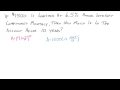
Understanding Compound Interest and Exponential Functions

Interactive Video
•
Mathematics
•
9th - 10th Grade
•
Hard

Nancy Jackson
FREE Resource
10 questions
Show all answers
1.
MULTIPLE CHOICE QUESTION
30 sec • 1 pt
What is the primary application of exponential functions discussed in the video?
Compound interest calculation
Simple interest calculation
Quadratic equation solving
Linear growth analysis
2.
MULTIPLE CHOICE QUESTION
30 sec • 1 pt
In the compound interest formula, what does 'P' represent?
The number of compounding periods
The principal amount
The accumulated amount
The interest rate
3.
MULTIPLE CHOICE QUESTION
30 sec • 1 pt
What is the significance of the number 'e' in continuous compounding?
It is the base of natural logarithms
It represents the number of compounding periods
It is the interest rate
It is the principal amount
4.
MULTIPLE CHOICE QUESTION
30 sec • 1 pt
How is the interest rate expressed in the compound interest formula?
As a fraction
As a decimal
As a whole number
As a percentage
5.
MULTIPLE CHOICE QUESTION
30 sec • 1 pt
If an account is compounded monthly, what is the value of 'n' in the formula?
4
12
1
365
6.
MULTIPLE CHOICE QUESTION
30 sec • 1 pt
What is the accumulated amount after 10 years for $1500 at 6.5% annual interest compounded monthly?
$3,000.00
$2,500.00
$2,868.28
$2,000.00
7.
MULTIPLE CHOICE QUESTION
30 sec • 1 pt
Which formula is used for continuous compounding?
A = P(1 + rt)
A = P + rt
A = P * e^(rt)
A = P(1 + r/n)^(nt)
Access all questions and much more by creating a free account
Create resources
Host any resource
Get auto-graded reports

Continue with Google

Continue with Email

Continue with Classlink

Continue with Clever
or continue with

Microsoft
%20(1).png)
Apple

Others
Already have an account?


