
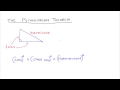
Understanding the Pythagorean Theorem

Interactive Video
•
Mathematics
•
6th - 7th Grade
•
Hard

Jennifer Brown
FREE Resource
10 questions
Show all answers
1.
MULTIPLE CHOICE QUESTION
30 sec • 1 pt
What is a right triangle?
A triangle with all sides equal
A triangle with no equal sides
A triangle with one 90-degree angle
A triangle with all angles equal
2.
MULTIPLE CHOICE QUESTION
30 sec • 1 pt
Which side of a right triangle is the longest?
The side adjacent to the right angle
The side opposite the largest angle
The side opposite the smallest angle
The side opposite the right angle
3.
MULTIPLE CHOICE QUESTION
30 sec • 1 pt
What are the two sides that form the right angle in a right triangle called?
Hypotenuse
Legs
Bases
Arms
4.
MULTIPLE CHOICE QUESTION
30 sec • 1 pt
What does the Pythagorean theorem state?
The square of the hypotenuse is equal to the sum of the squares of the other two sides
The square of one leg is equal to the sum of the squares of the other two sides
The sum of the angles in a triangle is 180 degrees
The sum of the sides of a triangle is equal to the hypotenuse
5.
MULTIPLE CHOICE QUESTION
30 sec • 1 pt
In the Pythagorean theorem, what is the formula for the hypotenuse?
Hypotenuse = leg1^2 + leg2^2
Hypotenuse = leg1 + leg2
Hypotenuse^2 = leg1 + leg2
Hypotenuse^2 = leg1^2 + leg2^2
6.
MULTIPLE CHOICE QUESTION
30 sec • 1 pt
If one leg of a right triangle is 5 units and the other is 8 units, what is the length of the hypotenuse?
15 units
Square root of 89 units
13 units
10 units
7.
MULTIPLE CHOICE QUESTION
30 sec • 1 pt
What is the approximate decimal value of the square root of 89?
9.93
8.94
9.43
9.33
Access all questions and much more by creating a free account
Create resources
Host any resource
Get auto-graded reports

Continue with Google

Continue with Email

Continue with Classlink

Continue with Clever
or continue with

Microsoft
%20(1).png)
Apple

Others
Already have an account?


