
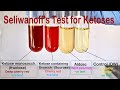
Understanding the Selivanov's Test

Interactive Video
•
Chemistry
•
10th - 12th Grade
•
Practice Problem
•
Hard

Jennifer Brown
FREE Resource
10 questions
Show all answers
1.
MULTIPLE CHOICE QUESTION
30 sec • 1 pt
What is the primary purpose of the Selivanov's Test?
To identify keto sugars with at least five carbon atoms
To measure the acidity of a solution
To detect the presence of proteins
To determine the boiling point of a liquid
2.
MULTIPLE CHOICE QUESTION
30 sec • 1 pt
Which of the following is a common example of a keto sugar?
Glucose
Galactose
Fructose
Mannose
3.
MULTIPLE CHOICE QUESTION
30 sec • 1 pt
Who devised the Selivanov's Test?
Theodore Selivanov
Dmitri Mendeleev
Louis Pasteur
Marie Curie
4.
MULTIPLE CHOICE QUESTION
30 sec • 1 pt
What is the main component of the Selivanov's reagent?
Sulfuric acid
Resorcinol and hydrochloric acid
Sodium chloride
Ethanol
5.
MULTIPLE CHOICE QUESTION
30 sec • 1 pt
What happens to keto sugars during the Selivanov's Test?
They undergo oxidation
They are rapidly dehydrated
They form a precipitate
They change to a blue color
6.
MULTIPLE CHOICE QUESTION
30 sec • 1 pt
What color indicates a positive result for keto sugars in the Selivanov's Test?
Blue
Green
Cherry red
Yellow
7.
MULTIPLE CHOICE QUESTION
30 sec • 1 pt
Why do aldo sugars give a slower reaction in the Selivanov's Test?
They have more carbon atoms
They lack a ketone group
They are less reactive with the reagent
They are more soluble
Access all questions and much more by creating a free account
Create resources
Host any resource
Get auto-graded reports

Continue with Google

Continue with Email

Continue with Classlink

Continue with Clever
or continue with

Microsoft
%20(1).png)
Apple

Others
Already have an account?

