
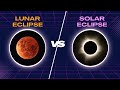
Understanding Eclipses: Lunar and Solar

Interactive Video
•
Physics
•
6th - 8th Grade
•
Practice Problem
•
Hard

Jennifer Brown
FREE Resource
10 questions
Show all answers
1.
MULTIPLE CHOICE QUESTION
30 sec • 1 pt
What celestial event is being discussed in this video?
Eclipses
Comet sightings
Meteor showers
Planetary alignments
2.
MULTIPLE CHOICE QUESTION
30 sec • 1 pt
What is a key characteristic of a lunar eclipse?
It happens at night
It is shorter in duration than a solar eclipse
It requires eye protection
It occurs during a new moon
3.
MULTIPLE CHOICE QUESTION
30 sec • 1 pt
Why are lunar eclipses more frequently observed than solar eclipses?
The Earth's shadow is larger
They occur during the day
They require special equipment to view
The moon's shadow is larger
4.
MULTIPLE CHOICE QUESTION
30 sec • 1 pt
What makes observing a solar eclipse challenging?
It requires a telescope
It occurs at night
It is only visible in a narrow path
It happens every month
5.
MULTIPLE CHOICE QUESTION
30 sec • 1 pt
What safety precaution is necessary when viewing a solar eclipse?
Viewing at night
Wearing eye protection
Using a telescope
Standing in a shadow
6.
MULTIPLE CHOICE QUESTION
30 sec • 1 pt
What is a similarity between lunar and solar eclipses?
Both occur during the day
Both require eye protection
Both are celestial events
Both are visible from anywhere on Earth
7.
MULTIPLE CHOICE QUESTION
30 sec • 1 pt
How long does a typical lunar eclipse last?
About 8 minutes
1 to 2 hours
All night
A few seconds
Access all questions and much more by creating a free account
Create resources
Host any resource
Get auto-graded reports

Continue with Google

Continue with Email

Continue with Classlink

Continue with Clever
or continue with

Microsoft
%20(1).png)
Apple

Others
Already have an account?


