
Understanding Infinitives and Their Uses

Interactive Video
•
English
•
9th - 10th Grade
•
Practice Problem
•
Hard

Richard Gonzalez
FREE Resource
Read more
15 questions
Show all answers
1.
MULTIPLE CHOICE QUESTION
30 sec • 1 pt
What is the basic structure of a normal infinitive?
To + auxiliary verb + base form
To + past participle
To + verb + ing
To + base form of the verb
2.
MULTIPLE CHOICE QUESTION
30 sec • 1 pt
Which of the following is an example of a normal infinitive?
To go
To have been
To be running
To have gone
3.
MULTIPLE CHOICE QUESTION
30 sec • 1 pt
What additional component does a perfect infinitive include compared to a normal infinitive?
A preposition
A modal verb
A gerund form
An auxiliary verb 'have'
4.
MULTIPLE CHOICE QUESTION
30 sec • 1 pt
Which of the following is a correct example of a perfect infinitive?
To have seen
To see
To seen
To be seeing
5.
MULTIPLE CHOICE QUESTION
30 sec • 1 pt
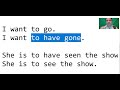
How does 'I want to go' differ from 'I want to have gone'?
Both refer to past actions.
Both refer to future actions.
'I want to go' refers to a current or future action, while 'I want to have gone' refers to a past action.
'I want to go' refers to a past action, while 'I want to have gone' refers to a future action.
6.
MULTIPLE CHOICE QUESTION
30 sec • 1 pt
In the sentence 'She is to have seen the show', what does the perfect infinitive indicate?
A future action
An ongoing action
A current action
A past action
7.
MULTIPLE CHOICE QUESTION
30 sec • 1 pt
What does the phrase 'the plane is to have arrived on time' imply?
The plane is expected to arrive in the future.
The plane was expected to arrive in the past.
The plane is currently arriving.
The plane will arrive soon.
Access all questions and much more by creating a free account
Create resources
Host any resource
Get auto-graded reports

Continue with Google

Continue with Email

Continue with Classlink

Continue with Clever
or continue with

Microsoft
%20(1).png)
Apple

Others
Already have an account?


