
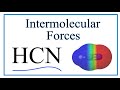
Intermolecular Forces in HCN

Interactive Video
•
Chemistry
•
10th - 12th Grade
•
Practice Problem
•
Hard

Jackson Turner
FREE Resource
Read more
10 questions
Show all answers
1.
MULTIPLE CHOICE QUESTION
30 sec • 1 pt
What type of compound is HCN?
Covalent
Amphoteric
Ionic
Metallic
2.
MULTIPLE CHOICE QUESTION
30 sec • 1 pt
What is the shape of the HCN molecule?
Bent
Trigonal planar
Linear
Tetrahedral
3.
MULTIPLE CHOICE QUESTION
30 sec • 1 pt
Which atom in HCN has a partial negative charge due to electronegativity?
Oxygen
Nitrogen
Carbon
Hydrogen
4.
MULTIPLE CHOICE QUESTION
30 sec • 1 pt
Why doesn't HCN exhibit hydrogen bonding?
Hydrogen is bonded to fluorine
Hydrogen is bonded to nitrogen
Hydrogen is bonded to oxygen
Hydrogen is bonded to carbon
5.
MULTIPLE CHOICE QUESTION
30 sec • 1 pt
What type of intermolecular force is primarily present in HCN?
Hydrogen bonding
Ionic bonding
Dipole-dipole forces
Metallic bonding
6.
MULTIPLE CHOICE QUESTION
30 sec • 1 pt
Which of the following forces is also present in HCN besides dipole-dipole forces?
Covalent bonding
London dispersion forces
Hydrogen bonding
Ionic forces
7.
MULTIPLE CHOICE QUESTION
30 sec • 1 pt
What is the significance of the dipole in HCN?
It is weaker than London dispersion forces
It is the primary force between molecules
It results in hydrogen bonding
It causes the molecule to be non-polar
Access all questions and much more by creating a free account
Create resources
Host any resource
Get auto-graded reports

Continue with Google

Continue with Email

Continue with Classlink

Continue with Clever
or continue with

Microsoft
%20(1).png)
Apple

Others
Already have an account?


