
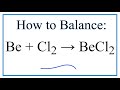
Ionic Charges and Balancing Equations

Interactive Video
•
Chemistry
•
9th - 10th Grade
•
Practice Problem
•
Hard

Sophia Harris
FREE Resource
Read more
6 questions
Show all answers
1.
MULTIPLE CHOICE QUESTION
30 sec • 1 pt
What is the first step in balancing a chemical equation?
Counting the atoms on each side
Adding coefficients to the products
Removing excess reactants
Changing the chemical formulas
2.
MULTIPLE CHOICE QUESTION
30 sec • 1 pt
When balancing the equation for Be + Cl2, what assumption is made if no coefficient is written?
The coefficient is zero
The coefficient is two
The coefficient is one
The coefficient is three
3.
MULTIPLE CHOICE QUESTION
30 sec • 1 pt
What does a balanced chemical equation ensure?
More atoms on the reactant side
Equal number of each type of atom on both sides
More atoms on the product side
Different types of atoms on each side
4.
MULTIPLE CHOICE QUESTION
30 sec • 1 pt
Why is the compound formed in the reaction Be + Cl2 called beryllium chloride?
Chlorine is in group 2 of the periodic table
Beryllium and chlorine form a neutral compound
Chlorine has a 2+ ionic charge
Beryllium is in group 1 of the periodic table
5.
MULTIPLE CHOICE QUESTION
30 sec • 1 pt
What is the ionic charge of beryllium in the compound BeCl2?
2+
1-
1+
2-
6.
MULTIPLE CHOICE QUESTION
30 sec • 1 pt
How do the ionic charges of beryllium and chlorine balance in BeCl2?
Beryllium's 2- charge balances with two chlorine atoms each having a 1+ charge
Beryllium's 1+ charge balances with one chlorine atom having a 1- charge
Beryllium's 2+ charge balances with two chlorine atoms each having a 1- charge
Beryllium's 1- charge balances with one chlorine atom having a 1+ charge
Access all questions and much more by creating a free account
Create resources
Host any resource
Get auto-graded reports

Continue with Google

Continue with Email

Continue with Classlink

Continue with Clever
or continue with

Microsoft
%20(1).png)
Apple

Others
Already have an account?


