
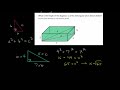
Diagonal Lengths and Pythagorean Theorem

Interactive Video
•
Mathematics
•
9th - 10th Grade
•
Practice Problem
•
Hard

Patricia Brown
FREE Resource
Read more
10 questions
Show all answers
1.
MULTIPLE CHOICE QUESTION
30 sec • 1 pt
What is the main objective of the problem discussed in the video?
To find the volume of a rectangular prism
To calculate the surface area of a cube
To determine the length of the diagonal in a rectangular prism
To measure the perimeter of a triangle
2.
MULTIPLE CHOICE QUESTION
30 sec • 1 pt
Which geometric shape is formed on the bottom rectangle to apply the Pythagorean theorem?
An isosceles triangle
An equilateral triangle
A right triangle
A scalene triangle
3.
MULTIPLE CHOICE QUESTION
30 sec • 1 pt
What are the side lengths of the right triangle on the bottom rectangle?
6 and 9
3 and 5
4 and 7
5 and 8
4.
MULTIPLE CHOICE QUESTION
30 sec • 1 pt
What is the value of x squared in the context of the problem?
49
65
100
81
5.
MULTIPLE CHOICE QUESTION
30 sec • 1 pt
What is the approximate value of the diagonal D after rounding to the nearest tenth?
8.1
8.2
8.3
8.4
6.
MULTIPLE CHOICE QUESTION
30 sec • 1 pt
Why can't the square root of 69 be simplified further?
Because 69 is a perfect square
Because 69 is a prime number
Because 69 is an even number
Because 69 is the product of two prime numbers
7.
MULTIPLE CHOICE QUESTION
30 sec • 1 pt
What is the general formula for finding the diagonal of a rectangular prism?
a^2 + b^2 + c^2 = f^2
a^2 + b^2 + c^2 = d^2
a^2 + b^2 + c^2 = e^2
a^2 + b^2 = c^2
Access all questions and much more by creating a free account
Create resources
Host any resource
Get auto-graded reports

Continue with Google

Continue with Email

Continue with Classlink

Continue with Clever
or continue with

Microsoft
%20(1).png)
Apple

Others
Already have an account?


