
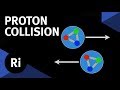
Particle Physics Concepts and Collisions

Interactive Video
•
Physics
•
11th - 12th Grade
•
Practice Problem
•
Hard

Patricia Brown
FREE Resource
Read more
10 questions
Show all answers
1.
MULTIPLE CHOICE QUESTION
30 sec • 1 pt
What is NOT a common misconception about proton collisions?
Dark matter is knocked off during collisions
Protons are made of quarks
Higgs boson is hidden inside protons
Protons contain secret particles
2.
MULTIPLE CHOICE QUESTION
30 sec • 1 pt
What analogy is used to explain force exchange at the particle level?
Two cars colliding
Humans on an ice skating rink
A ball rolling down a hill
A pendulum swinging
3.
MULTIPLE CHOICE QUESTION
30 sec • 1 pt
In the quantum world, what can happen when two particles collide?
They bounce off each other
They merge into a larger particle
They cease to exist and form new particles
They split into smaller particles
4.
MULTIPLE CHOICE QUESTION
30 sec • 1 pt
Which of the following is NOT a conserved quantity in physics?
Momentum
Mass
Energy
Charge
5.
MULTIPLE CHOICE QUESTION
30 sec • 1 pt
What is the significance of conserved quantities in particle collisions?
They allow for the transformation of particles
They ensure particles remain unchanged
They prevent particles from interacting
They determine the speed of particles
6.
MULTIPLE CHOICE QUESTION
30 sec • 1 pt
What is the primary focus of particle physics?
Counting particles
Measuring particle size
Conserved quantities
Naming particles
7.
MULTIPLE CHOICE QUESTION
30 sec • 1 pt
What is a Feynman diagram used to illustrate?
The speed of light
The transformation of particles
The gravitational force
The structure of atoms
Access all questions and much more by creating a free account
Create resources
Host any resource
Get auto-graded reports

Continue with Google

Continue with Email

Continue with Classlink

Continue with Clever
or continue with

Microsoft
%20(1).png)
Apple

Others
Already have an account?

