
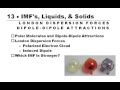
Intermolecular Forces and Their Effects

Interactive Video
•
Chemistry
•
10th - 12th Grade
•
Practice Problem
•
Hard

Patricia Brown
FREE Resource
Read more
10 questions
Show all answers
1.
MULTIPLE CHOICE QUESTION
30 sec • 1 pt
Which type of intermolecular force is present in all molecules with electron clouds?
Covalent bonding
Ionic bonding
Hydrogen bonding
London dispersion forces
2.
MULTIPLE CHOICE QUESTION
30 sec • 1 pt
What causes dipole-dipole attractions between molecules?
Equal distribution of electrons
Full positive and negative charges
Presence of hydrogen atoms
Partial positive and negative charges
3.
MULTIPLE CHOICE QUESTION
30 sec • 1 pt
How do London dispersion forces arise?
Hydrogen bonding
Permanent dipoles
Temporary polarization of electron clouds
Ionic interactions
4.
MULTIPLE CHOICE QUESTION
30 sec • 1 pt
Which factor increases the strength of London dispersion forces?
Smaller electron clouds
Presence of hydrogen bonds
Less polarizable electron clouds
Larger and more polarizable electron clouds
5.
MULTIPLE CHOICE QUESTION
30 sec • 1 pt
Which molecule is likely to have stronger London dispersion forces, iodine or fluorine?
Iodine
Fluorine
Both have equal strength
Neither has London dispersion forces
6.
MULTIPLE CHOICE QUESTION
30 sec • 1 pt
What is the primary reason for the higher melting point of larger hydrocarbons?
Stronger covalent bonds
Greater ionic character
More hydrogen bonding
Stronger London dispersion forces
7.
MULTIPLE CHOICE QUESTION
30 sec • 1 pt
Which intermolecular force is generally stronger, dipole-dipole or London dispersion?
London dispersion
Dipole-dipole
Both are equally strong
Neither is strong
Access all questions and much more by creating a free account
Create resources
Host any resource
Get auto-graded reports

Continue with Google

Continue with Email

Continue with Classlink

Continue with Clever
or continue with

Microsoft
%20(1).png)
Apple

Others
Already have an account?


