
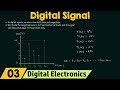
Error Analysis in Digital Signals

Interactive Video
•
Physics
•
9th - 10th Grade
•
Practice Problem
•
Hard

Patricia Brown
FREE Resource
Read more
10 questions
Show all answers
1.
MULTIPLE CHOICE QUESTION
30 sec • 1 pt
What is the key difference between discrete time signals and digital signals?
Discrete time signals do not discretize any axis.
Digital signals discretize both time and magnitude.
Discrete time signals discretize both time and magnitude.
Digital signals discretize only the time axis.
2.
MULTIPLE CHOICE QUESTION
30 sec • 1 pt
How can the interval for discretizing the time axis be calculated?
By subtracting T0 from T1.
By adding T1 and T0.
By multiplying T1 and T0.
By dividing T1 by T0.
3.
MULTIPLE CHOICE QUESTION
30 sec • 1 pt
In the temperature example, what is the allowed temperature level for 9°C in digital signals?
9°C
15°C
0°C
45°C
4.
MULTIPLE CHOICE QUESTION
30 sec • 1 pt
Why is it important to select the lower value when discretizing the magnitude axis?
To make calculations easier.
To avoid using zero.
To minimize the error.
To increase the error.
5.
MULTIPLE CHOICE QUESTION
30 sec • 1 pt
What happens to the error when the number of levels is increased in digital signals?
The error increases.
The error becomes zero.
The error remains the same.
The error decreases.
6.
MULTIPLE CHOICE QUESTION
30 sec • 1 pt
In the voltage example, what is the error when the voltage is 2 volts and the levels are 0 and 5 volts?
1 volt
2 volts
0 volts
5 volts
7.
MULTIPLE CHOICE QUESTION
30 sec • 1 pt
How can the error be reduced to zero in the voltage example?
By decreasing the number of levels.
By increasing the number of levels.
By using only two levels.
By keeping the levels constant.
Access all questions and much more by creating a free account
Create resources
Host any resource
Get auto-graded reports

Continue with Google

Continue with Email

Continue with Classlink

Continue with Clever
or continue with

Microsoft
%20(1).png)
Apple

Others
Already have an account?


