
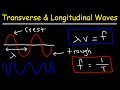
Transverse and Longitudinal Waves Concepts

Interactive Video
•
Physics, Science, Mathematics
•
9th - 10th Grade
•
Practice Problem
•
Hard

Patricia Brown
FREE Resource
Read more
10 questions
Show all answers
1.
MULTIPLE CHOICE QUESTION
30 sec • 1 pt
What is the top part of a wave called?
Trough
Crest
Amplitude
Wavelength
2.
MULTIPLE CHOICE QUESTION
30 sec • 1 pt
How can the speed of a wave be calculated?
By subtracting frequency from wavelength
By multiplying wavelength by frequency
By dividing wavelength by frequency
By adding wavelength and frequency
3.
MULTIPLE CHOICE QUESTION
30 sec • 1 pt
What unit is used to measure frequency?
Hertz
Seconds
Newtons
Meters
4.
MULTIPLE CHOICE QUESTION
30 sec • 1 pt
In a transverse wave, how do the oscillations move relative to the wave direction?
In the same direction
Perpendicular
In a circular motion
Parallel
5.
MULTIPLE CHOICE QUESTION
30 sec • 1 pt
Which of the following is an example of a transverse wave?
Seismic wave
Water wave
Pressure wave
Sound wave
6.
MULTIPLE CHOICE QUESTION
30 sec • 1 pt
What is a characteristic of longitudinal waves?
They do not have oscillations
They move in a circular pattern
Oscillations are parallel to wave direction
Oscillations are perpendicular to wave direction
7.
MULTIPLE CHOICE QUESTION
30 sec • 1 pt
Which wave type is a sound wave an example of?
Surface wave
Longitudinal wave
Transverse wave
Electromagnetic wave
Access all questions and much more by creating a free account
Create resources
Host any resource
Get auto-graded reports

Continue with Google

Continue with Email

Continue with Classlink

Continue with Clever
or continue with

Microsoft
%20(1).png)
Apple

Others
Already have an account?


