
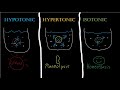
Isotonic, Hypotonic, and Hypertonic Solutions

Interactive Video
•
Biology, Chemistry, Science
•
9th - 10th Grade
•
Practice Problem
•
Medium

Patricia Brown
Used 3+ times
FREE Resource
Read more
10 questions
Show all answers
1.
MULTIPLE CHOICE QUESTION
30 sec • 1 pt
What is a solute in a solution?
The liquid part of a solution
The mixture of solute and solvent
The substance that is dissolved
The substance that dissolves other substances
2.
MULTIPLE CHOICE QUESTION
30 sec • 1 pt
What is the role of a solvent in a solution?
It is the substance that is dissolved
It is the gas part of a solution
It is the substance that dissolves the solute
It is the solid part of a solution
3.
MULTIPLE CHOICE QUESTION
30 sec • 1 pt
In a hypotonic solution, what happens to the cell?
It expands and may burst
It becomes isotonic
It remains the same
It shrinks
4.
MULTIPLE CHOICE QUESTION
30 sec • 1 pt
What is the term for a cell bursting in a hypotonic solution?
Diffusion
Cytolysis
Plasmolysis
Homeostasis
5.
MULTIPLE CHOICE QUESTION
30 sec • 1 pt
What occurs to a cell in a hypertonic solution?
It becomes isotonic
It expands
It remains unchanged
It shrinks and may die
6.
MULTIPLE CHOICE QUESTION
30 sec • 1 pt
What is the process called when a cell shrinks in a hypertonic solution?
Equilibrium
Cytolysis
Plasmolysis
Osmosis
7.
MULTIPLE CHOICE QUESTION
30 sec • 1 pt
In an isotonic solution, how does water move in relation to the cell?
Water rushes into the cell
Water rushes out of the cell
Water moves in and out at an equal rate
Water does not move at all
Access all questions and much more by creating a free account
Create resources
Host any resource
Get auto-graded reports

Continue with Google

Continue with Email

Continue with Classlink

Continue with Clever
or continue with

Microsoft
%20(1).png)
Apple

Others
Already have an account?

