
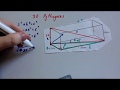
3D Geometry and Pythagorean Theorem

Interactive Video
•
Mathematics, Physics, Science
•
9th - 10th Grade
•
Practice Problem
•
Hard

Patricia Brown
FREE Resource
Read more
10 questions
Show all answers
1.
MULTIPLE CHOICE QUESTION
30 sec • 1 pt
What is the primary goal when applying 3D Pythagoras to a cuboid?
To find the volume of the cuboid
To determine the surface area of the cuboid
To calculate the diagonal from one corner to the opposite corner
To measure the perimeter of the cuboid
2.
MULTIPLE CHOICE QUESTION
30 sec • 1 pt
What are the dimensions of the cuboid used in the example?
Width: 20 cm, Length: 10 cm, Height: 15 cm
Width: 10 cm, Length: 15 cm, Height: 20 cm
Width: 15 cm, Length: 20 cm, Height: 10 cm
Width: 10 cm, Length: 20 cm, Height: 15 cm
3.
MULTIPLE CHOICE QUESTION
30 sec • 1 pt
How do you calculate the diagonal on the base of the cuboid?
By multiplying the width and length
By subtracting the width from the length
By using the Pythagorean theorem on the width and length
By adding the width and length
4.
MULTIPLE CHOICE QUESTION
30 sec • 1 pt
What is the length of the diagonal on the base of the cuboid?
30 cm
25 cm
15 cm
20 cm
5.
MULTIPLE CHOICE QUESTION
30 sec • 1 pt
What is the final length of the diagonal through the cuboid?
25.9 cm
26.9 cm
27.9 cm
28.9 cm
6.
MULTIPLE CHOICE QUESTION
30 sec • 1 pt
What shape is the base of the pyramid in the second problem?
Rectangular
Triangular
Square
Circular
7.
MULTIPLE CHOICE QUESTION
30 sec • 1 pt
What is the first step in solving the pyramid problem?
Finding the diagonal of the base
Calculating the area of the base
Finding the height of the pyramid
Measuring the perimeter of the base
Access all questions and much more by creating a free account
Create resources
Host any resource
Get auto-graded reports

Continue with Google

Continue with Email

Continue with Classlink

Continue with Clever
or continue with

Microsoft
%20(1).png)
Apple

Others
Already have an account?


