
Planetary Science and Orbits

Interactive Video
•
Science, Geography, Physics
•
6th - 8th Grade
•
Practice Problem
•
Hard

Patricia Brown
FREE Resource
Read more
10 questions
Show all answers
1.
MULTIPLE CHOICE QUESTION
30 sec • 1 pt
What is the main focus of the Earth Science Reagent Review Podcast?
Chemical reactions
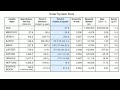
Solar system data chart
Biology experiments
Weather patterns
2.
MULTIPLE CHOICE QUESTION
30 sec • 1 pt
Which planet is closest to the Sun?
Mars
Mercury
Earth
Venus
3.
MULTIPLE CHOICE QUESTION
30 sec • 1 pt
According to Kepler's third law, what happens as a planet's distance from the Sun increases?
Its revolution period decreases
Its revolution period increases
Its rotation period decreases
Its rotation period increases
4.
MULTIPLE CHOICE QUESTION
30 sec • 1 pt
Which planet has a day longer than its year?
Venus
Mars
Earth
Jupiter
5.
MULTIPLE CHOICE QUESTION
30 sec • 1 pt
What does an eccentricity close to zero indicate about a planet's orbit?
The planet is very dense
The orbit is very circular
The orbit is very elongated
The planet rotates quickly
6.
MULTIPLE CHOICE QUESTION
30 sec • 1 pt
Which planets are considered terrestrial?
Earth, Mars, Jupiter, Saturn
Mercury, Venus, Earth, Mars
Venus, Earth, Neptune, Uranus
Jupiter, Saturn, Uranus, Neptune
7.
MULTIPLE CHOICE QUESTION
30 sec • 1 pt
What is the relative mass of Earth in the solar system data chart?
0.5
1
2
10
Access all questions and much more by creating a free account
Create resources
Host any resource
Get auto-graded reports

Continue with Google

Continue with Email

Continue with Classlink

Continue with Clever
or continue with

Microsoft
%20(1).png)
Apple

Others
Already have an account?


