
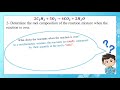
Limiting and Excess Reactants in Reactions

Interactive Video
•
Chemistry, Science
•
9th - 12th Grade
•
Practice Problem
•
Hard

Patricia Brown
FREE Resource
Read more
10 questions
Show all answers
1.
MULTIPLE CHOICE QUESTION
30 sec • 1 pt
What is a characteristic of a stoichiometric mixture?
The reaction never stops.
There is always an excess reactant.
The reactants are totally consumed.
The reactants are partially consumed.
2.
MULTIPLE CHOICE QUESTION
30 sec • 1 pt
In a non-stoichiometric mixture, what happens to the limiting reactant?
It remains unchanged.
It is totally consumed.
It is partially consumed.
It increases in quantity.
3.
MULTIPLE CHOICE QUESTION
30 sec • 1 pt
How do you determine if a reaction mixture is stoichiometric?
By observing the color change.
By measuring the temperature change.
By checking if the reactants are in excess.
By comparing the ratios of the reactants.
4.
MULTIPLE CHOICE QUESTION
30 sec • 1 pt
What is the ratio of C2H2 to O2 in a stoichiometric mixture for the given reaction?
1:5
2:5
4:10
2:2
5.
MULTIPLE CHOICE QUESTION
30 sec • 1 pt
How many moles of CO2 are produced from 4 moles of C2H2 in a stoichiometric reaction?
10 moles
2 moles
8 moles
4 moles
6.
MULTIPLE CHOICE QUESTION
30 sec • 1 pt
In a non-stoichiometric mixture, which reactant is the limiting reactant?
The one that is not consumed.
The one that is in excess.
The one with the lower initial moles.
The one with the higher initial moles.
7.
MULTIPLE CHOICE QUESTION
30 sec • 1 pt
How many moles of O2 are reacted in the non-stoichiometric example?
3 moles
0.5 moles
1 mole
2.5 moles
Access all questions and much more by creating a free account
Create resources
Host any resource
Get auto-graded reports

Continue with Google

Continue with Email

Continue with Classlink

Continue with Clever
or continue with

Microsoft
%20(1).png)
Apple

Others
Already have an account?


