
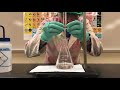
Titration Techniques and Concepts

Interactive Video
•
Chemistry, Science, Mathematics
•
9th - 12th Grade
•
Practice Problem
•
Hard

Patricia Brown
FREE Resource
Read more
10 questions
Show all answers
1.
MULTIPLE CHOICE QUESTION
30 sec • 1 pt
What is the first step you should take before starting a titration experiment?
Ensure all safety equipment is worn.
Start adding the titrant to the analyte.
Add the indicator to the solution.
Measure the final volume of the solution.
2.
MULTIPLE CHOICE QUESTION
30 sec • 1 pt
Why is it important to remove the funnel after filling the burette?
To avoid spilling the solution.
To prevent contamination of the solution.
To ensure accurate volume readings.
To allow the solution to mix properly.
3.
MULTIPLE CHOICE QUESTION
30 sec • 1 pt
What is the role of phenolphthalein in a titration involving sodium hydroxide and acetic acid?
It increases the reaction rate.
It acts as a catalyst.
It neutralizes the acid.
It serves as an indicator.
4.
MULTIPLE CHOICE QUESTION
30 sec • 1 pt
What should you do when you first see a flash of pink during the titration?
Record the volume immediately.
Swirl the solution and add titrant slowly.
Add more titrant quickly.
Stop the titration immediately.
5.
MULTIPLE CHOICE QUESTION
30 sec • 1 pt
How can you ensure that you do not miss the endpoint during a titration?
Use a different indicator.
Stop the titration as soon as you see any color change.
Add large amounts of titrant at once.
Add titrant drop by drop as you approach the endpoint.
6.
MULTIPLE CHOICE QUESTION
30 sec • 1 pt
What is the significance of the equivalence point in a titration?
It is when the moles of titrant equal the moles of analyte.
It is when the solution changes color.
It is when the solution reaches its maximum volume.
It is when the reaction starts.
7.
MULTIPLE CHOICE QUESTION
30 sec • 1 pt
How do you calculate the moles of sodium hydroxide used in the titration?
By adding the volumes of titrant and analyte.
By measuring the initial volume of the analyte.
By using the molarity and volume of the titrant.
By subtracting the final volume from the initial volume.
Access all questions and much more by creating a free account
Create resources
Host any resource
Get auto-graded reports

Continue with Google

Continue with Email

Continue with Classlink

Continue with Clever
or continue with

Microsoft
%20(1).png)
Apple

Others
Already have an account?
Popular Resources on Wayground

8 questions
Spartan Way - Classroom Responsible

Quiz
•
9th - 12th Grade
15 questions
Fractions on a Number Line
Quiz
•
3rd Grade
14 questions
Boundaries & Healthy Relationships

Lesson
•
6th - 8th Grade
20 questions
Equivalent Fractions
Quiz
•
3rd Grade
3 questions
Integrity and Your Health
Lesson
•
6th - 8th Grade
25 questions
Multiplication Facts
Quiz
•
5th Grade
9 questions
FOREST Perception
Lesson
•
KG
20 questions
Main Idea and Details
Quiz
•
5th Grade
Discover more resources for Chemistry
22 questions
Unit 9 Gas Law Quiz
Quiz
•
10th Grade
20 questions
Types of Chemical Reactions
Quiz
•
9th - 12th Grade
13 questions
Solubility Curves
Quiz
•
10th Grade
20 questions
momentum and impulse
Quiz
•
9th - 12th Grade
22 questions
Solubility Curve Practice
Quiz
•
10th Grade
40 questions
Unit 3 (Part 1) Chemical Equations & Reactions Review Game
Quiz
•
8th - 12th Grade
20 questions
Naming Covalent Compounds
Quiz
•
11th Grade
35 questions
Types of Chemical Reactions
Quiz
•
9th - 12th Grade