
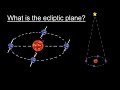
Celestial Mechanics and Observations

Interactive Video
•
Physics, Science, Geography
•
9th - 10th Grade
•
Practice Problem
•
Hard

Patricia Brown
FREE Resource
Read more
5 questions
Show all answers
1.
MULTIPLE CHOICE QUESTION
30 sec • 1 pt
What is the primary purpose of understanding the ecliptic plane?
To predict weather patterns
To measure the distance to the Moon
To observe the movement of celestial bodies
To calculate the Earth's age
2.
MULTIPLE CHOICE QUESTION
30 sec • 1 pt
How often does the Earth complete one revolution around the Sun?
Every 30 days
Every 24 hours
Every 365 and a quarter days
Every 1000 days
3.
MULTIPLE CHOICE QUESTION
30 sec • 1 pt
What is the angle between the Moon's orbital plane and the ecliptic plane?
10 degrees
0 degrees
15 degrees
5 degrees
4.
MULTIPLE CHOICE QUESTION
30 sec • 1 pt
Why does the North Star, Polaris, remain in a fixed position relative to Earth?
Because it is very close to Earth
Because it is directly above the Earth's axis of rotation
Because it moves at the same speed as Earth
Because it is part of the solar system
5.
MULTIPLE CHOICE QUESTION
30 sec • 1 pt
What is the significance of the ecliptic plane in celestial observations?
It helps in predicting solar flares
It is used to measure time
It serves as a reference for locating celestial objects
It determines the Earth's magnetic field
Access all questions and much more by creating a free account
Create resources
Host any resource
Get auto-graded reports

Continue with Google

Continue with Email

Continue with Classlink

Continue with Clever
or continue with

Microsoft
%20(1).png)
Apple

Others
Already have an account?


