
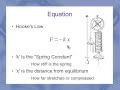
Spring Force and Hooke's Law

Interactive Video
•
Physics, Science, Mathematics
•
9th - 10th Grade
•
Practice Problem
•
Hard

Patricia Brown
FREE Resource
Read more
10 questions
Show all answers
1.
MULTIPLE CHOICE QUESTION
30 sec • 1 pt
What is a common characteristic of all spring-like objects?
They have a restoring force.
They are made of metal.
They can only be compressed.
They cannot be stretched.
2.
MULTIPLE CHOICE QUESTION
30 sec • 1 pt
What does Hooke's Law state about the force exerted by a spring?
It is proportional to the square of the displacement.
It is inversely proportional to the displacement.
It is directly proportional to the displacement.
It is constant regardless of displacement.
3.
MULTIPLE CHOICE QUESTION
30 sec • 1 pt
What is the relationship between force and displacement in Hooke's Law?
Force is unrelated to displacement.
Force is directly proportional to displacement.
Force is equal to displacement.
Force is inversely proportional to displacement.
4.
MULTIPLE CHOICE QUESTION
30 sec • 1 pt
What does a large spring constant indicate about a spring?
The spring is very long.
The spring is very short.
The spring is very soft.
The spring is very stiff.
5.
MULTIPLE CHOICE QUESTION
30 sec • 1 pt
If a spring with a constant of 10 N/m is stretched by 1 meter, what force does it exert?
-20 N
10 N
20 N
-10 N
6.
MULTIPLE CHOICE QUESTION
30 sec • 1 pt
How does the force exerted by a spring change as it is stretched further?
The force becomes zero.
The force increases.
The force decreases.
The force remains constant.
7.
MULTIPLE CHOICE QUESTION
30 sec • 1 pt
What is the unit of the spring constant?
Newtons per meter
Meters
Newtons
Meters per second
Access all questions and much more by creating a free account
Create resources
Host any resource
Get auto-graded reports

Continue with Google

Continue with Email

Continue with Classlink

Continue with Clever
or continue with

Microsoft
%20(1).png)
Apple

Others
Already have an account?


