
Characteristics and Naming of Acids

Interactive Video
•
Chemistry, Science, Biology
•
9th - 10th Grade
•
Practice Problem
•
Hard

Patricia Brown
FREE Resource
Read more
10 questions
Show all answers
1.
MULTIPLE CHOICE QUESTION
30 sec • 1 pt
What is a common characteristic of all acids?
They contain hydrogen in the form of H+.
They are always oxy acids.
They are always binary.
They contain oxygen.
2.
MULTIPLE CHOICE QUESTION
30 sec • 1 pt
What defines a binary acid?
It contains a polyatomic ion.
It is composed of two elements, one of which is hydrogen.
It always contains oxygen.
It is a gas at room temperature.
3.
MULTIPLE CHOICE QUESTION
30 sec • 1 pt
How is hydrochloric acid (HCl) formed?
By dissolving hydrogen chloride gas in water.
By combining hydrogen with oxygen.
By reacting hydrogen with a polyatomic ion.
By mixing hydrogen with a metal.
4.
MULTIPLE CHOICE QUESTION
30 sec • 1 pt
What is the naming convention for binary acids?
They are named with the suffix 'ic'.
They are named with the suffix 'ous'.
They are named with the prefix 'Hydro' followed by the non-metal and 'acid'.
They are named with the prefix 'Oxy'.
5.
MULTIPLE CHOICE QUESTION
30 sec • 1 pt
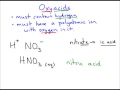
What is a key component of oxy acids?
They contain only two elements.
They include a polyatomic ion with oxygen.
They are always gaseous.
They do not contain hydrogen.
6.
MULTIPLE CHOICE QUESTION
30 sec • 1 pt
How is nitric acid (HNO3) named based on its polyatomic ion?
The 'ate' in nitrate changes to 'ous' to form nitric acid.
The 'ate' in nitrate changes to 'ic' to form nitric acid.
The 'ite' in nitrite changes to 'ous' to form nitric acid.
The 'ite' in nitrite changes to 'ic' to form nitric acid.
7.
MULTIPLE CHOICE QUESTION
30 sec • 1 pt
What happens to the name of a polyatomic ion ending in 'ite' when it forms an acid?
It changes to 'ic'.
It changes to 'ous'.
It remains the same.
It changes to 'ate'.
Access all questions and much more by creating a free account
Create resources
Host any resource
Get auto-graded reports

Continue with Google

Continue with Email

Continue with Classlink

Continue with Clever
or continue with

Microsoft
%20(1).png)
Apple

Others
Already have an account?

