
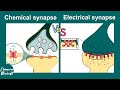
Chemical and Electrical Synapses

Interactive Video
•
Biology, Science, Chemistry
•
9th - 10th Grade
•
Practice Problem
•
Hard

Patricia Brown
FREE Resource
Read more
10 questions
Show all answers
1.
MULTIPLE CHOICE QUESTION
30 sec • 1 pt
What is the primary structural component of electrical synapses that allows direct cytoplasmic connection?
Connexons
Dendrites
Receptors
Axons
2.
MULTIPLE CHOICE QUESTION
30 sec • 1 pt
In a chemical synapse, what happens when the presynaptic action potential reaches the nerve terminal?
The synapse becomes electrical
Neurotransmitter is released
The synapse stops functioning
The postsynaptic receptor is destroyed
3.
MULTIPLE CHOICE QUESTION
30 sec • 1 pt
Which of the following is NOT a benefit of electrical synapses?
Presence in invertebrates
Fast transmission
Bidirectional signaling
High specificity
4.
MULTIPLE CHOICE QUESTION
30 sec • 1 pt
What is the role of connexins in electrical synapses?
They inhibit synaptic transmission
They are neurotransmitters
They are protein subunits of connexons
They form the postsynaptic receptors
5.
MULTIPLE CHOICE QUESTION
30 sec • 1 pt
Why are chemical synapses considered highly modulatory?
They have fast transmission
They are found only in invertebrates
They allow bidirectional signaling
They can change in response to stimuli
6.
MULTIPLE CHOICE QUESTION
30 sec • 1 pt
What is the main reason for the transition from electrical to chemical synapses during brain development?
To eliminate synaptic plasticity
To decrease specificity
To allow for asynchronous activity
To increase speed of transmission
7.
MULTIPLE CHOICE QUESTION
30 sec • 1 pt
Which type of synapse is characterized by high plasticity?
Neither type
Electrical synapse
Chemical synapse
Both types
Access all questions and much more by creating a free account
Create resources
Host any resource
Get auto-graded reports

Continue with Google

Continue with Email

Continue with Classlink

Continue with Clever
or continue with

Microsoft
%20(1).png)
Apple

Others
Already have an account?


