
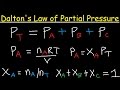
Mastering Dalton's Law and Partial Pressures in Gaseous Mixtures

Interactive Video
•
Chemistry, Physics, Science
•
9th - 12th Grade
•
Practice Problem
•
Hard

Patricia Brown
FREE Resource
Read more
10 questions
Show all answers
1.
MULTIPLE CHOICE QUESTION
30 sec • 1 pt
What does Dalton's Law of Partial Pressure state?
The total pressure of a gas is equal to the average of the individual partial pressures.
The total pressure of a gas is equal to the difference of the individual partial pressures.
The total pressure of a gas is equal to the product of the individual partial pressures.
The total pressure of a gas is equal to the sum of the individual partial pressures.
2.
MULTIPLE CHOICE QUESTION
30 sec • 1 pt
How can you calculate the partial pressure of a gas using mole fractions?
By multiplying the mole fraction by the total pressure.
By dividing the total pressure by the mole fraction.
By adding the mole fraction to the total pressure.
By subtracting the mole fraction from the total pressure.
3.
MULTIPLE CHOICE QUESTION
30 sec • 1 pt
In the example problem, what is the mole fraction of argon in the storage tank?
0.2
0.3
0.4
0.1
4.
MULTIPLE CHOICE QUESTION
30 sec • 1 pt
What is the partial pressure of oxygen in the storage tank example?
200 torr
300 torr
500 torr
400 torr
5.
MULTIPLE CHOICE QUESTION
30 sec • 1 pt
How do you calculate the total pressure using the Ideal Gas Law?
By adding the total moles to RT and dividing by V.
By multiplying the total moles by RT and dividing by V.
By dividing the total moles by RT and multiplying by V.
By subtracting the total moles from RT and dividing by V.
6.
MULTIPLE CHOICE QUESTION
30 sec • 1 pt
In the Ideal Gas Law example, what is the partial pressure of nitrogen gas?
75 atm
61.5 atm
36.9 atm
24.6 atm
7.
MULTIPLE CHOICE QUESTION
30 sec • 1 pt
What is the total pressure in the Ideal Gas Law example?
36.9 atm
24.6 atm
75 atm
61.5 atm
Access all questions and much more by creating a free account
Create resources
Host any resource
Get auto-graded reports

Continue with Google

Continue with Email

Continue with Classlink

Continue with Clever
or continue with

Microsoft
%20(1).png)
Apple

Others
Already have an account?

