
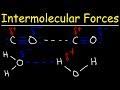
Intermolecular Forces Dipole-Dipole Interactions and Hydrogen Bonding Explained

Interactive Video
•
Chemistry, Science, Biology
•
9th - 12th Grade
•
Practice Problem
•
Hard

Patricia Brown
FREE Resource
Read more
10 questions
Show all answers
1.
MULTIPLE CHOICE QUESTION
30 sec • 1 pt
What type of interaction occurs between polar molecules like acetone?
Covalent bonding
Ionic bonding
Metallic bonding
Dipole-dipole interaction
2.
MULTIPLE CHOICE QUESTION
30 sec • 1 pt
Which molecule is used as an example to explain dipole-dipole interactions?
Methane
Carbon monoxide
Ammonia
Water
3.
MULTIPLE CHOICE QUESTION
30 sec • 1 pt
Hydrogen bonding occurs when hydrogen is attached to which of the following elements?
Carbon
Sulfur
Nitrogen
Chlorine
4.
MULTIPLE CHOICE QUESTION
30 sec • 1 pt
What effect does hydrogen bonding have on a molecule's boiling point?
Decreases it
No effect
Varies randomly
Increases it
5.
MULTIPLE CHOICE QUESTION
30 sec • 1 pt
Which molecule has a higher boiling point due to hydrogen bonding?
Dimethyl ether
Propane
Ethanol
Methane
6.
MULTIPLE CHOICE QUESTION
30 sec • 1 pt
Why does ethanol have a higher solubility in water compared to dimethyl ether?
Ethanol is nonpolar
Dimethyl ether is metallic
Ethanol has hydrogen bonds
Dimethyl ether is ionic
7.
MULTIPLE CHOICE QUESTION
30 sec • 1 pt
Which molecule is more soluble in water, ethanol or butanol?
Ethanol
Butanol
Both are equally soluble
Neither is soluble
Access all questions and much more by creating a free account
Create resources
Host any resource
Get auto-graded reports

Continue with Google

Continue with Email

Continue with Classlink

Continue with Clever
or continue with

Microsoft
%20(1).png)
Apple

Others
Already have an account?


