
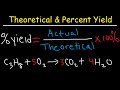
Calculating Theoretical And Percent Yields In Combustion Reactions

Interactive Video
•
Chemistry, Science, Mathematics
•
9th - 10th Grade
•
Practice Problem
•
Hard

Patricia Brown
FREE Resource
Read more
10 questions
Show all answers
1.
MULTIPLE CHOICE QUESTION
30 sec • 1 pt
What is the first step in calculating the theoretical and percent yield of a compound?
Identify the limiting reactant
Write a balanced chemical equation
Measure the actual yield
Calculate the molar mass
2.
MULTIPLE CHOICE QUESTION
30 sec • 1 pt
In a combustion reaction, what are the typical products formed?
Carbon dioxide and water
Carbon dioxide and hydrogen
Carbon monoxide and water
Oxygen and water
3.
MULTIPLE CHOICE QUESTION
30 sec • 1 pt
Why is it important to identify the limiting reactant in a chemical reaction?
To balance the chemical equation
To measure the actual yield
To calculate the theoretical yield
To determine the excess reactant
4.
MULTIPLE CHOICE QUESTION
30 sec • 1 pt
What is the theoretical yield in a chemical reaction?
The amount of reactant used
The maximum amount of product possible
The amount of product actually obtained
The efficiency of the reaction
5.
MULTIPLE CHOICE QUESTION
30 sec • 1 pt
How is percent yield calculated?
Actual yield plus theoretical yield
Theoretical yield minus actual yield
Theoretical yield divided by actual yield times 100
Actual yield divided by theoretical yield times 100
6.
MULTIPLE CHOICE QUESTION
30 sec • 1 pt
What is the molar mass of propane (C3H8)?
50 grams per mole
30 grams per mole
44 grams per mole
36 grams per mole
7.
MULTIPLE CHOICE QUESTION
30 sec • 1 pt
What is the molar ratio of C3H8 to CO2 in the combustion reaction?
1:1
1:2
1:3
2:3
Access all questions and much more by creating a free account
Create resources
Host any resource
Get auto-graded reports

Continue with Google

Continue with Email

Continue with Classlink

Continue with Clever
or continue with

Microsoft
%20(1).png)
Apple

Others
Already have an account?

