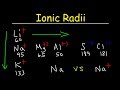
Understanding Ionic Radii

Interactive Video
•
Chemistry, Science
•
9th - 12th Grade
•
Practice Problem
•
Hard

Mia Campbell
FREE Resource
Read more
10 questions
Show all answers
1.
MULTIPLE CHOICE QUESTION
30 sec • 1 pt
What happens to the size of ions as you move down a group in the periodic table?
They get smaller.
They get larger.
They remain the same.
They fluctuate randomly.
2.
MULTIPLE CHOICE QUESTION
30 sec • 1 pt
What is the general trend for ionic radii as you move across a period?
Ionic radii fluctuate randomly.
Ionic radii remain constant.
Ionic radii decrease.
Ionic radii increase.
3.
MULTIPLE CHOICE QUESTION
30 sec • 1 pt
Why is the magnesium ion larger than the beryllium ion?
Beryllium has a higher nuclear charge.
Magnesium has more electron shells.
Magnesium is higher on the periodic table.
Magnesium has fewer electrons.
4.
MULTIPLE CHOICE QUESTION
30 sec • 1 pt
Which ion is smaller, calcium or gallium, and why?
Calcium, because it has a lower charge.
Gallium, because it is to the right of calcium on the periodic table.
Calcium, because it is above gallium on the periodic table.
Gallium, because it has fewer protons.
5.
MULTIPLE CHOICE QUESTION
30 sec • 1 pt
When comparing potassium and bromide ions, which is larger and why?
Bromide, because it has fewer electrons.
Potassium, because it has more protons.
Bromide, because it has more electron shells.
Potassium, because it is a cation.
6.
MULTIPLE CHOICE QUESTION
30 sec • 1 pt
How does the size of a sodium ion compare to its parent atom?
The sodium ion is smaller.
They are the same size.
The sodium ion has more electrons.
The sodium ion is larger.
7.
MULTIPLE CHOICE QUESTION
30 sec • 1 pt
What is the effect of adding an electron to a chlorine atom to form a chloride ion?
The chloride ion loses an electron shell.
The chloride ion becomes larger.
The chloride ion remains the same size.
The chloride ion becomes smaller.
Access all questions and much more by creating a free account
Create resources
Host any resource
Get auto-graded reports

Continue with Google

Continue with Email

Continue with Classlink

Continue with Clever
or continue with

Microsoft
%20(1).png)
Apple

Others
Already have an account?
Similar Resources on Wayground

11 questions
Understanding Solubility and Electrolytes
Interactive video
•
9th - 12th Grade
11 questions
Kuis Metabolisme dan Katabolisme
Interactive video
•
10th - 12th Grade
8 questions
GCSE Secondary Maths Age 13-17 - Geometry & Measures: Circle Theorems - Explained
Interactive video
•
10th - 12th Grade
11 questions
Understanding Reactivity and Shielding in the Periodic Table
Interactive video
•
9th - 12th Grade
11 questions
Muscle Contraction Mechanisms and Structures
Interactive video
•
9th - 12th Grade
6 questions
The Nature of Electricity: Static Electricity
Interactive video
•
10th - 12th Grade
Popular Resources on Wayground
15 questions
Fractions on a Number Line

Quiz
•
3rd Grade
20 questions
Equivalent Fractions
Quiz
•
3rd Grade
25 questions
Multiplication Facts
Quiz
•
5th Grade
54 questions
Analyzing Line Graphs & Tables
Quiz
•
4th Grade
22 questions
fractions
Quiz
•
3rd Grade
20 questions
Main Idea and Details
Quiz
•
5th Grade
20 questions
Context Clues
Quiz
•
6th Grade
15 questions
Equivalent Fractions
Quiz
•
4th Grade
Discover more resources for Chemistry
20 questions
Types of Chemical Reactions
Quiz
•
9th - 12th Grade
10 questions
Formative 3BC: Ionic v Covalent Bonds
Quiz
•
9th Grade
10 questions
Exploring Stoichiometry Concepts
Interactive video
•
6th - 10th Grade
20 questions
Mixed Bonding Naming
Quiz
•
9th Grade
20 questions
Naming & Writing Chemical Formulas
Quiz
•
10th Grade
20 questions
Chemical Reactions
Quiz
•
9th Grade
20 questions
Practice: E-Con, Orbital Notation, Noble Gas Notation
Quiz
•
10th Grade
20 questions
Covalent Bonding
Quiz
•
10th Grade