
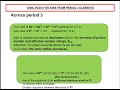
Ionic Radius and Isoelectronic Species

Interactive Video
•
Chemistry, Science
•
10th - 12th Grade
•
Practice Problem
•
Hard

Aiden Montgomery
FREE Resource
Read more
10 questions
Show all answers
1.
MULTIPLE CHOICE QUESTION
30 sec • 1 pt
What does the term 'isoelectronic' refer to?
Species with the same atomic mass
Species with the same number of neutrons
Species with the same number of protons
Species with the same number of electrons and electronic configuration
2.
MULTIPLE CHOICE QUESTION
30 sec • 1 pt
Which of the following ions is isoelectronic with the oxide ion?
Nitride ion
Chloride ion
Aluminum ion
Sodium ion
3.
MULTIPLE CHOICE QUESTION
30 sec • 1 pt
What happens to the ionic radius as you move from sodium ion to silicon ion across period 3?
It increases
It decreases
It fluctuates
It remains constant
4.
MULTIPLE CHOICE QUESTION
30 sec • 1 pt
Why does the size of phosphide ion increase compared to silicon ion?
Due to a smaller principal quantum number
Due to a decrease in electron repulsion
Due to an additional electron shell
Due to a decrease in proton number
5.
MULTIPLE CHOICE QUESTION
30 sec • 1 pt
Which period do the cations in the comparison of isoelectronic species come from?
Period 3
Period 2
Period 1
Period 4
6.
MULTIPLE CHOICE QUESTION
30 sec • 1 pt
What is the main reason for the smallest size of aluminum ion among isoelectronic species?
It has the largest proton number
It has the smallest number of electrons
It has the largest electron shell
It has the smallest atomic mass
7.
MULTIPLE CHOICE QUESTION
30 sec • 1 pt
Which ion is the largest among the isoelectronic species discussed?
Sodium ion
Aluminum ion
Oxide ion
Nitride ion
Access all questions and much more by creating a free account
Create resources
Host any resource
Get auto-graded reports

Continue with Google

Continue with Email

Continue with Classlink

Continue with Clever
or continue with

Microsoft
%20(1).png)
Apple

Others
Already have an account?

