
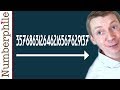
Understanding Truncatable Primes

Interactive Video
•
Mathematics, Fun
•
6th - 10th Grade
•
Practice Problem
•
Hard
Standards-aligned

Aiden Montgomery
FREE Resource
Standards-aligned
Read more
10 questions
Show all answers
1.
MULTIPLE CHOICE QUESTION
30 sec • 1 pt
What makes the 24-digit number discussed in the video special?
It is divisible by 10.
It is a palindrome.
It remains prime when truncated from the left.
It is the smallest prime number.
Tags
CCSS.4.OA.B.4
2.
MULTIPLE CHOICE QUESTION
30 sec • 1 pt
Which of the following numbers can be a valid last digit for a left-truncatable prime?
6
9
4
7
Tags
CCSS.4.OA.C.5
3.
MULTIPLE CHOICE QUESTION
30 sec • 1 pt
What is the largest known right-truncatable prime number?
1,979,339,339
73,939,133
739,397
357,686,312,646,216,567,629,137
Tags
CCSS.4.OA.B.4
4.
MULTIPLE CHOICE QUESTION
30 sec • 1 pt
What happens when you remove digits from the right of a right-truncatable prime?
It becomes a palindrome.
It remains a prime number.
It becomes divisible by 10.
It becomes a composite number.
Tags
CCSS.4.OA.B.4
5.
MULTIPLE CHOICE QUESTION
30 sec • 1 pt
Which number is both left and right-truncatable?
739,397
357,686,312,646,216,567,629,137
73,939,133
1,979,339,339
Tags
CCSS.4.OA.B.4
6.
MULTIPLE CHOICE QUESTION
30 sec • 1 pt
What is a deletable prime?
A prime that is only divisible by 1 and itself.
A prime that is divisible by 2.
A prime that is a palindrome.
A prime that remains prime when any digit is removed.
Tags
CCSS.4.OA.B.4
7.
MULTIPLE CHOICE QUESTION
30 sec • 1 pt
What is the significance of the number 415,673 in the context of deletable primes?
It is the largest known deletable prime.
It can be reduced to a single-digit prime by removing digits.
It is a palindrome.
It is divisible by 10.
Access all questions and much more by creating a free account
Create resources
Host any resource
Get auto-graded reports

Continue with Google

Continue with Email

Continue with Classlink

Continue with Clever
or continue with

Microsoft
%20(1).png)
Apple

Others
Already have an account?


