
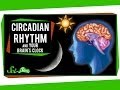
Understanding Circadian Rhythms

Interactive Video
•
Biology, Science
•
9th - 12th Grade
•
Practice Problem
•
Medium

Lucas Foster
Used 3+ times
FREE Resource
Read more
10 questions
Show all answers
1.
MULTIPLE CHOICE QUESTION
30 sec • 1 pt
What can happen if you frequently disrupt your circadian rhythm?
You will have improved concentration.
You may feel exhausted and confused.
You will sleep better at night.
You become more energetic.
2.
MULTIPLE CHOICE QUESTION
30 sec • 1 pt
What is the origin of the term 'circadian'?
It is a modern scientific term.
It originates from the French word for 'cycle'.
It is derived from the Latin word 'circadium'.
It comes from the Greek word for 'day'.
3.
MULTIPLE CHOICE QUESTION
30 sec • 1 pt
Which part of the brain is primarily responsible for regulating circadian rhythms?
The amygdala
The hypothalamus
The cerebellum
The hippocampus
4.
MULTIPLE CHOICE QUESTION
30 sec • 1 pt
What role does the supermatic nucleus (SCN) play in circadian rhythms?
It controls muscle movements.
It manages emotional responses.
It regulates the release of digestive enzymes.
It responds to light and dark signals.
5.
MULTIPLE CHOICE QUESTION
30 sec • 1 pt
When are humans generally at their cognitive best according to circadian rhythms?
Evening
Afternoon
Late morning
Early morning
6.
MULTIPLE CHOICE QUESTION
30 sec • 1 pt
What is a natural part of our daily rhythms that many species do not exhibit?
Once a day sleep pattern
Twice a day feeding pattern
Constant alertness
Continuous activity
7.
MULTIPLE CHOICE QUESTION
30 sec • 1 pt
What is a common time for an afternoon lull in alertness?
12:00 p.m. to 1:00 p.m.
2:00 p.m. to 3:00 p.m.
4:00 p.m. to 5:00 p.m.
10:00 a.m. to 12:00 p.m.
Access all questions and much more by creating a free account
Create resources
Host any resource
Get auto-graded reports

Continue with Google

Continue with Email

Continue with Classlink

Continue with Clever
or continue with

Microsoft
%20(1).png)
Apple

Others
Already have an account?


