
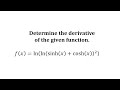
Understanding Derivatives and Logarithms

Interactive Video
•
Mathematics
•
10th - 12th Grade
•
Practice Problem
•
Hard
Standards-aligned

Amelia Wright
FREE Resource
Standards-aligned
Read more
10 questions
Show all answers
1.
MULTIPLE CHOICE QUESTION
30 sec • 1 pt
What is the exponential form of hyperbolic sine of x?
e^x + e^(-x)
e^x - e^(-x)
(e^x - e^(-x))/2
(e^x + e^(-x))/2
2.
MULTIPLE CHOICE QUESTION
30 sec • 1 pt
After simplifying, what does the expression e^x - e^(-x) + e^x + e^(-x) become?
2e^x
4e^x
0
e^x
3.
MULTIPLE CHOICE QUESTION
30 sec • 1 pt
What is the correct interpretation of the exponent 2 in the expression natural log(e^x)^2?
It is attached to e^x
It is inside the parentheses
It is the square of the logarithm
It is a product of logarithms
4.
MULTIPLE CHOICE QUESTION
30 sec • 1 pt
What is the base of the logarithm in natural log(e^x)?
10
x
2
e
5.
MULTIPLE CHOICE QUESTION
30 sec • 1 pt
How does natural log(e^x) simplify?
e^x
x
1
0
6.
MULTIPLE CHOICE QUESTION
30 sec • 1 pt
What is the derivative of natural log x squared?
x^2
1/x
2/x
2x
7.
MULTIPLE CHOICE QUESTION
30 sec • 1 pt
What property allows us to simplify natural log(e^x) to x?
Power property
Product property
Quotient property
Base property
Tags
CCSS.8.EE.B.5
Access all questions and much more by creating a free account
Create resources
Host any resource
Get auto-graded reports

Continue with Google

Continue with Email

Continue with Classlink

Continue with Clever
or continue with

Microsoft
%20(1).png)
Apple

Others
Already have an account?


