
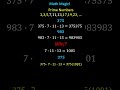
Understanding Multiplication with Primes

Interactive Video
•
Mathematics
•
5th - 8th Grade
•
Practice Problem
•
Hard
Standards-aligned

Jackson Turner
FREE Resource
Standards-aligned
Read more
5 questions
Show all answers
1.
MULTIPLE CHOICE QUESTION
30 sec • 1 pt
What is the result when a three-digit number is multiplied by the primes 71 and 13?
A six-digit number that is the original number reversed
A six-digit number that is the original number halved
A six-digit number that is the original number repeated twice
A six-digit number that is the original number squared
Tags
CCSS.4.NBT.B.5
2.
MULTIPLE CHOICE QUESTION
30 sec • 1 pt
Why does multiplying 711 by 13 result in 1,1?
Because it simplifies the multiplication process
Because it represents a mathematical trick
Because 1,1 is a placeholder for a larger number
Because 711 is a special number
Tags
CCSS.2.NBT.A.3
3.
MULTIPLE CHOICE QUESTION
30 sec • 1 pt
How is the number 1,1 rewritten in the explanation?
As 1000 + 1
As 100 + 1
As 10 + 1
As 1 + 1
Tags
CCSS.5.NBT.A.2
4.
MULTIPLE CHOICE QUESTION
30 sec • 1 pt
What is the result of multiplying 375 by 1,000?
3,750
37,500
375
375,000
Tags
CCSS.5.NBT.A.2
5.
MULTIPLE CHOICE QUESTION
30 sec • 1 pt
What is the final result when 375 is multiplied by 1,000 and then added to 375?
375,750
375,000
375,100
375,375
Tags
CCSS.5.NBT.A.2
Access all questions and much more by creating a free account
Create resources
Host any resource
Get auto-graded reports

Continue with Google

Continue with Email

Continue with Classlink

Continue with Clever
or continue with

Microsoft
%20(1).png)
Apple

Others
Already have an account?


