
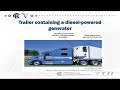
Transport Refrigeration Systems Overview

Interactive Video
•
Science, Physics, Chemistry
•
9th - 12th Grade
•
Practice Problem
•
Hard

Mia Campbell
FREE Resource
Read more
10 questions
Show all answers
1.
MULTIPLE CHOICE QUESTION
30 sec • 1 pt
What is a key difference between transport refrigeration systems and other refrigeration systems?
Transport systems do not require backup systems.
Transport systems are mobile and handle various conditions.
Transport systems are designed for fixed temperatures.
Transport systems are stationary.
2.
MULTIPLE CHOICE QUESTION
30 sec • 1 pt
Which refrigerant is suitable for medium and low temperature refrigeration in transport systems?
134A
404A
R22
R410A
3.
MULTIPLE CHOICE QUESTION
30 sec • 1 pt
What is the function of a quench valve in a transport refrigeration system?
To act as a backup compressor.
To decrease the temperature of the condenser.
To inject liquid refrigerant into the suction line during low load periods.
To increase refrigerant flow during high load periods.
4.
MULTIPLE CHOICE QUESTION
30 sec • 1 pt
What is the typical length range for refrigerated trailers?
10 to 20 feet
28 to 53 feet
60 to 80 feet
5 to 15 feet
5.
MULTIPLE CHOICE QUESTION
30 sec • 1 pt
What is the primary insulation material used in refrigerated trailers?
Fiberglass
Spray foam
Metal sheets
Wood panels
6.
MULTIPLE CHOICE QUESTION
30 sec • 1 pt
Where is the compressor typically located in small capacity refrigerated trucks?
Under the driver's seat
In the engine compartment
Inside the cargo box
On the roof of the truck
7.
MULTIPLE CHOICE QUESTION
30 sec • 1 pt
What allows refrigerated trucks to operate even when the vehicle is off?
A wind turbine
A battery pack
An external generator
A solar panel system
Access all questions and much more by creating a free account
Create resources
Host any resource
Get auto-graded reports

Continue with Google

Continue with Email

Continue with Classlink

Continue with Clever
or continue with

Microsoft
%20(1).png)
Apple

Others
Already have an account?


