
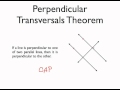
Understanding Perpendicular Transversals

Interactive Video
•
Mathematics, English, World Languages, Physics, Chemistry, Biology, Science, Geography, History, Arts, Social Studies, Computers, Physical Ed, Fun, Professional Development, Architecture, Business, Design, Education, Instructional Technology, Journalism, Life Skills, Moral Science, Philosophy, Performing Arts, Religious Studies, Special Education, Specialty, Other
•
7th - 10th Grade
•
Practice Problem
•
Hard

Emma Peterson
FREE Resource
Read more
7 questions
Show all answers
1.
MULTIPLE CHOICE QUESTION
30 sec • 1 pt
What is the main focus of the lesson 3-4 that is introduced in the video?
Corresponding Angles Theorem
Parallel Lines Theorem
Perpendicular Transversals Theorem
Alternate Interior Angles Theorem
2.
MULTIPLE CHOICE QUESTION
30 sec • 1 pt
How can you identify perpendicular lines?
They form acute angles
They form obtuse angles
They intersect to form right angles
They never intersect
3.
MULTIPLE CHOICE QUESTION
30 sec • 1 pt
What does the Perpendicular Transversals Theorem state?
If a line is perpendicular to one of two parallel lines, it is perpendicular to the other.
If a line is perpendicular to one of two intersecting lines, it is perpendicular to the other.
If a line is parallel to one of two perpendicular lines, it is parallel to the other.
If a line is parallel to one of two intersecting lines, it is parallel to the other.
4.
MULTIPLE CHOICE QUESTION
30 sec • 1 pt
Which concept is used in the proof of the Perpendicular Transversals Theorem?
Vertical Angles
Corresponding Angles
Supplementary Angles
Alternate Interior Angles
5.
MULTIPLE CHOICE QUESTION
30 sec • 1 pt
What is the measure of a right angle?
45°
60°
120°
90°
6.
MULTIPLE CHOICE QUESTION
30 sec • 1 pt
Why are the corresponding angles in the proof both 90°?
Because they are supplementary
Because they are congruent
Because they are complementary
Because they are adjacent
7.
MULTIPLE CHOICE QUESTION
30 sec • 1 pt
What conclusion can be drawn if two lines intersect to form a right angle?
The lines are parallel
The lines are perpendicular
The lines are coincident
The lines are skew
Access all questions and much more by creating a free account
Create resources
Host any resource
Get auto-graded reports

Continue with Google

Continue with Email

Continue with Classlink

Continue with Clever
or continue with

Microsoft
%20(1).png)
Apple

Others
Already have an account?


