
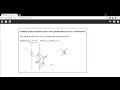
Understanding Angles with Parallel Lines and Transversals

Interactive Video
•
Mathematics
•
7th - 10th Grade
•
Practice Problem
•
Hard
Standards-aligned

Mia Campbell
FREE Resource
Standards-aligned
Read more
10 questions
Show all answers
1.
MULTIPLE CHOICE QUESTION
30 sec • 1 pt
What happens when two parallel lines are intersected by a transversal?
All angles become equal.
Some angles are equal, and some are supplementary.
All angles are supplementary.
No angles are equal.
Tags
CCSS.7.G.B.5
2.
MULTIPLE CHOICE QUESTION
30 sec • 1 pt
What is the relationship between vertical angles?
They are always complementary.
They are always supplementary.
They are always different.
They are always equal.
Tags
CCSS.7.G.B.5
3.
MULTIPLE CHOICE QUESTION
30 sec • 1 pt
If angle 7 is 51 degrees, what is the measure of angle 5?
180 degrees
90 degrees
129 degrees
51 degrees
Tags
CCSS.7.G.B.5
4.
MULTIPLE CHOICE QUESTION
30 sec • 1 pt
What is a linear pair of angles?
Two angles that add up to 90 degrees.
Two angles that are equal.
Two angles that are complementary.
Two angles that add up to 180 degrees.
Tags
CCSS.7.G.B.5
5.
MULTIPLE CHOICE QUESTION
30 sec • 1 pt
If angle 6 is 129 degrees, what is the measure of angle 8?
51 degrees
129 degrees
90 degrees
180 degrees
Tags
CCSS.7.G.B.5
6.
MULTIPLE CHOICE QUESTION
30 sec • 1 pt
How do you find the measure of angle 6 if angle 7 is 51 degrees?
Divide 51 by 2.
Multiply 51 by 2.
Subtract 51 from 180.
Add 51 to 180.
Tags
CCSS.7.G.B.5
7.
MULTIPLE CHOICE QUESTION
30 sec • 1 pt
What is the measure of angle 2 if angle 5 is 51 degrees?
129 degrees
180 degrees
51 degrees
90 degrees
Tags
CCSS.7.G.B.5
Access all questions and much more by creating a free account
Create resources
Host any resource
Get auto-graded reports

Continue with Google

Continue with Email

Continue with Classlink

Continue with Clever
or continue with

Microsoft
%20(1).png)
Apple

Others
Already have an account?


