
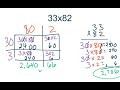
Exploring Partial Products in 2-Digit Multiplication

Interactive Video
•
Mathematics
•
6th - 10th Grade
•
Practice Problem
•
Hard
Standards-aligned

Aiden Montgomery
FREE Resource
Standards-aligned
10 questions
Show all answers
1.
MULTIPLE CHOICE QUESTION
30 sec • 1 pt
What method is being introduced for multiplying two-digit numbers?
Lattice method
Area model
Partial products
Standard algorithm
Tags
CCSS.4.NBT.B.5
2.
MULTIPLE CHOICE QUESTION
30 sec • 1 pt
What is the first step in solving multiplication using the area model?
Add the products
Multiply the units
Draw a rectangle
Expand the numbers
Tags
CCSS.4.NBT.B.5
3.
MULTIPLE CHOICE QUESTION
30 sec • 1 pt
What is the purpose of expanding numbers in both methods?
To increase accuracy
To simplify addition
To reduce the number of steps
To make multiplication easier
Tags
CCSS.4.NBT.B.5
4.
MULTIPLE CHOICE QUESTION
30 sec • 1 pt
How does the partial products method differ from the area model?
Partial products use a vertical setup
Partial products use a horizontal setup
Partial products require drawing rectangles
Partial products do not require number expansion
Tags
CCSS.4.NBT.B.5
5.
MULTIPLE CHOICE QUESTION
30 sec • 1 pt
What is the final step in both the partial products and area model methods?
Expanding numbers
Adding the partial products
Multiplying the digits
Drawing a rectangle
Tags
CCSS.4.NBT.B.5
6.
MULTIPLE CHOICE QUESTION
30 sec • 1 pt
In the example 43 times 12, what is the product obtained using both methods?
488
532
624
516
Tags
CCSS.5.NBT.B.5
7.
MULTIPLE CHOICE QUESTION
30 sec • 1 pt
What is emphasized about the alignment of numbers when adding partial products?
No alignment needed
Align by place values
Align by tens
Align by units
Tags
CCSS.4.NBT.B.5
Access all questions and much more by creating a free account
Create resources
Host any resource
Get auto-graded reports

Continue with Google

Continue with Email

Continue with Classlink

Continue with Clever
or continue with

Microsoft
%20(1).png)
Apple

Others
Already have an account?


