
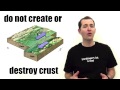
Transform Boundaries and Seismic Activity

Interactive Video
•
Science, Geography
•
6th - 10th Grade
•
Practice Problem
•
Hard

Liam Anderson
FREE Resource
Read more
10 questions
Show all answers
1.
MULTIPLE CHOICE QUESTION
30 sec • 1 pt
What are the three main types of plate boundaries?
Transform, Divergent, and Convergent
Transform, Convergent, and Parallel
Divergent, Convergent, and Parallel
Transform, Divergent, and Parallel
2.
MULTIPLE CHOICE QUESTION
30 sec • 1 pt
Which feature is NOT commonly observed at plate boundaries?
Seismic activity
Volcanic activity
Atmospheric pressure
Geochronology
3.
MULTIPLE CHOICE QUESTION
30 sec • 1 pt
What is geochronology?
The study of the Earth's crust age
The study of volcanic activity
The study of seismic activity
The study of ocean depths
4.
MULTIPLE CHOICE QUESTION
30 sec • 1 pt
How do transform boundaries differ from convergent and divergent boundaries?
They are found only in oceans
They destroy old crust
They create new crust
They neither create nor destroy crust
5.
MULTIPLE CHOICE QUESTION
30 sec • 1 pt
What is a characteristic feature of transform boundaries?
High topographic features
Deep seismic activity
Volcanoes spread out over a large area
High volcanic activity in a concentrated area
6.
MULTIPLE CHOICE QUESTION
30 sec • 1 pt
Where is the famous San Andreas Fault located?
Washington
Oregon
California
Nevada
7.
MULTIPLE CHOICE QUESTION
30 sec • 1 pt
At what rate do the plates at the San Andreas Fault slide past each other?
2 centimeters per year
4 centimeters per year
6 centimeters per year
8 centimeters per year
Access all questions and much more by creating a free account
Create resources
Host any resource
Get auto-graded reports

Continue with Google

Continue with Email

Continue with Classlink

Continue with Clever
or continue with

Microsoft
%20(1).png)
Apple

Others
Already have an account?


