
Exploring Chemical Bonding Concepts

Interactive Video
•
Science
•
6th - 10th Grade
•
Practice Problem
•
Medium
Standards-aligned

Olivia Brooks
Used 17+ times
FREE Resource
Standards-aligned
10 questions
Show all answers
1.
MULTIPLE CHOICE QUESTION
30 sec • 1 pt
What part of an atom is represented by the light in the analogy used in the video?
Neutrons
Electron cloud
Protons
Nucleus
Tags
NGSS.MS-PS1-1
2.
MULTIPLE CHOICE QUESTION
30 sec • 1 pt
What do the bugs around the light represent in the analogy?
Protons
Neutrons
Nucleus
Electrons
Tags
NGSS.MS-PS1-1
3.
MULTIPLE CHOICE QUESTION
30 sec • 1 pt
Which part of the atom is most likely to interact during chemical bonding?
Nucleus
Protons
Neutrons
Valence electrons
Tags
NGSS.HS-PS1-1
NGSS.HS-PS1-2
4.
MULTIPLE CHOICE QUESTION
30 sec • 1 pt
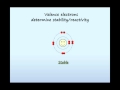
What determines an atom's stability and chemical reactivity?
Valence electrons
Nucleus size
Number of protons
Number of neutrons
Tags
NGSS.HS-PS1-1
NGSS.HS-PS1-2
5.
MULTIPLE CHOICE QUESTION
30 sec • 1 pt
According to the octet rule, how many electrons make an atom's outermost orbital stable?
8
2
4
6
6.
MULTIPLE CHOICE QUESTION
30 sec • 1 pt
What happens to an atom when its outermost orbital is full?
It loses electrons
It becomes stable
It gains protons
It becomes unstable
7.
MULTIPLE CHOICE QUESTION
30 sec • 1 pt
In ionic bonding, how do atoms achieve stability?
By losing neutrons
By gaining protons
By sharing electrons
By gaining or losing electrons
Access all questions and much more by creating a free account
Create resources
Host any resource
Get auto-graded reports

Continue with Google

Continue with Email

Continue with Classlink

Continue with Clever
or continue with

Microsoft
%20(1).png)
Apple

Others
Already have an account?


