
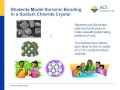
Exploring Ionic Bonding and Energy Levels

Interactive Video
•
Science
•
6th - 10th Grade
•
Practice Problem
•
Hard
Standards-aligned

Ethan Morris
FREE Resource
Standards-aligned
Read more
10 questions
Show all answers
1.
MULTIPLE CHOICE QUESTION
30 sec • 1 pt
What happens to the sodium atom when it loses an electron?
It remains neutral.
It becomes a positively charged ion.
It becomes a negatively charged ion.
It gains a proton.
Tags
NGSS.MS-PS1-2
2.
MULTIPLE CHOICE QUESTION
30 sec • 1 pt
Why does chlorine become a negatively charged ion in the formation of sodium chloride?
It gains a proton.
It loses an electron.
It gains an electron.
It loses a proton.
3.
MULTIPLE CHOICE QUESTION
30 sec • 1 pt
What is the charge of the chloride ion in a sodium chloride crystal?
Neutral
Positive
It varies
Negative
4.
MULTIPLE CHOICE QUESTION
30 sec • 1 pt
What is used to prevent the flask from cracking during the reaction between sodium metal and chlorine gas?
Water
Sand
Glass beads
Ice
5.
MULTIPLE CHOICE QUESTION
30 sec • 1 pt
What type of reaction occurs when sodium metal reacts with chlorine gas?
Endothermic
No reaction
Exothermic
Neutral
Tags
NGSS.MS-PS1-2
6.
MULTIPLE CHOICE QUESTION
30 sec • 1 pt
How many electrons does calcium lose when forming calcium chloride?
Four
Three
Two
One
7.
MULTIPLE CHOICE QUESTION
30 sec • 1 pt
What is the chemical formula for calcium chloride?
CaCl
CaCl2
Ca2Cl2
Ca2Cl
Tags
NGSS.MS-PS1-1
Access all questions and much more by creating a free account
Create resources
Host any resource
Get auto-graded reports

Continue with Google

Continue with Email

Continue with Classlink

Continue with Clever
or continue with

Microsoft
%20(1).png)
Apple

Others
Already have an account?


