
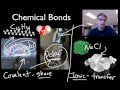
Exploring Chemical Bonds: Covalent vs. Ionic

Interactive Video
•
Chemistry
•
6th - 10th Grade
•
Practice Problem
•
Easy

Sophia Harris
Used 7+ times
FREE Resource
Read more
10 questions
Show all answers
1.
MULTIPLE CHOICE QUESTION
30 sec • 1 pt
What are chemical bonds?
None of the above
Neutral interactions between atoms
Repulsions between atoms or molecules
Attractions between atoms or molecules
2.
MULTIPLE CHOICE QUESTION
30 sec • 1 pt
Which type of bond involves sharing electrons equally?
Ionic bond
Polar covalent bond
Metallic bond
Non-polar covalent bond
3.
MULTIPLE CHOICE QUESTION
30 sec • 1 pt
In an ionic bond, what happens to the electrons?
They are shared equally
They are not involved
They are transferred between atoms
They are shared unequally
4.
MULTIPLE CHOICE QUESTION
30 sec • 1 pt
What is the octet rule?
Atoms seek to have eight electrons in their outer shell
Atoms seek to have eight neutrons in their nucleus
Atoms seek to have eight protons in their nucleus
Atoms seek to have eight bonds with other atoms
5.
MULTIPLE CHOICE QUESTION
30 sec • 1 pt
Which element has the highest electronegativity?
Oxygen
Fluorine
Francium
Chlorine
6.
MULTIPLE CHOICE QUESTION
30 sec • 1 pt
What is the electronegativity difference range for a polar covalent bond?
2.5 to 3.5
0.5 to 1.7
1.7 to 2.5
0.0 to 0.5
7.
MULTIPLE CHOICE QUESTION
30 sec • 1 pt
Why do water and diesel fuel not mix?
Both are non-polar
Both are polar
They have the same density
One is polar and the other is non-polar
Access all questions and much more by creating a free account
Create resources
Host any resource
Get auto-graded reports

Continue with Google

Continue with Email

Continue with Classlink

Continue with Clever
or continue with

Microsoft
%20(1).png)
Apple

Others
Already have an account?


