
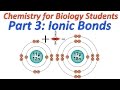
Ionic Bonding Essentials for Biology Students

Interactive Video
•
Chemistry
•
6th - 10th Grade
•
Practice Problem
•
Hard

Amelia Wright
FREE Resource
Read more
10 questions
Show all answers
1.
MULTIPLE CHOICE QUESTION
30 sec • 1 pt
What is the octet rule in the context of chemical bonding?
Atoms are happy when they have an odd number of electrons.
Atoms are happy when they have no electrons.
Atoms are happy when their outer orbitals are full.
Atoms are happy when they have an equal number of protons and neutrons.
2.
MULTIPLE CHOICE QUESTION
30 sec • 1 pt
How many electrons can the second orbital of an atom hold?
6
8
4
2
3.
MULTIPLE CHOICE QUESTION
30 sec • 1 pt
What happens when an atom's outer orbital is incomplete?
It loses all its electrons.
It trades or shares electrons with other atoms.
It becomes stable.
It gains protons.
4.
MULTIPLE CHOICE QUESTION
30 sec • 1 pt
Why is hydrogen considered an unhappy atom?
It has an equal number of protons and electrons.
It has no electrons.
It has too many electrons.
Its outer shell has a capacity of two but only has one electron.
5.
MULTIPLE CHOICE QUESTION
30 sec • 1 pt
What is the chemical name of table salt?
Sodium chloride
Calcium carbonate
Potassium chloride
Magnesium sulfate
6.
MULTIPLE CHOICE QUESTION
30 sec • 1 pt
What happens to sodium when it loses an electron?
It becomes neutral.
It gains a proton.
It becomes a positively charged ion.
It becomes a negatively charged ion.
7.
MULTIPLE CHOICE QUESTION
30 sec • 1 pt
What type of bond is formed when atoms trade electrons?
Covalent bond
Metallic bond
Ionic bond
Hydrogen bond
Access all questions and much more by creating a free account
Create resources
Host any resource
Get auto-graded reports

Continue with Google

Continue with Email

Continue with Classlink

Continue with Clever
or continue with

Microsoft
%20(1).png)
Apple

Others
Already have an account?


