
AP Biology Chi-Square
Authored by Lisa Thompson
Science
12th Grade
NGSS covered
Used 23+ times


AI Actions
Add similar questions
Adjust reading levels
Convert to real-world scenario
Translate activity
More...
Content View
Student View
15 questions
Show all answers
1.
MULTIPLE CHOICE QUESTION
1 min • 5 pts
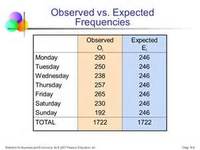
Find the degrees of freedom.
4
5
6
7
2.
MULTIPLE CHOICE QUESTION
1 min • 5 pts

The appropriate null hypothesis for performing a chi-square test is that
equal proportions of female and male teenagers are almost certain they will be married in 10 years.
there is no difference between the distributions of female and male teenagers' opinions about marriage in this sample.
there is no difference between the distributions of female and male teenagers' opinions about marriage in the population.
there is no association between gender and opinion about marriage in the sample.
there is no association between gender and opinion about marriage in the population.
3.
MULTIPLE CHOICE QUESTION
1 min • 5 pts

Mrs. Hock asks her class what their favorite ice cream flavor is. She wonders if the flavors are equally represented. The table shows the observed values. How many degrees of freedom are there?
4
3
2
1
4.
MULTIPLE CHOICE QUESTION
1 min • 5 pts

Mrs. Hock asks her class what their favorite ice cream flavor is. She wonders if the flavors are equally represented. The table shows the observed values. What is the Chi Square statistic?
4.4
0.221
3
3.2
5.
MULTIPLE CHOICE QUESTION
1 min • 5 pts
A chi-square test is used to test whether a 0 to 9 spinner is "fair" (that is, the outcomes are all equally likely). The spinner is spun 100 times, and the results are recorded. The expected counts for spinning a 5 will be
5
10
11.1
20
6.
MULTIPLE CHOICE QUESTION
1 min • 1 pt
If the findings of the research showed that the difference between the experimental and control group was relatively large, it would be said that it is
randomized
had confounding variables
statistically significant
had a standard deviation
7.
MULTIPLE CHOICE QUESTION
1 min • 1 pt
In an AP Biology experiment, students are testing the inheritance pattern of a particular trait in pea plants. They expect a 3:1 ratio of dominant to recessive phenotypes. After conducting the experiment, they observe 75 dominant and 25 recessive phenotypes. What is the expected number of recessive phenotypes if the ratio is correct?
A) 20
B) 25
C) 30
D) 35
Tags
NGSS.HS-LS3-3
Access all questions and much more by creating a free account
Create resources
Host any resource
Get auto-graded reports

Continue with Google

Continue with Email

Continue with Classlink

Continue with Clever
or continue with

Microsoft
%20(1).png)
Apple

Others
Already have an account?



