
Section 4.1 and 4.2 Probability and Stats
Authored by Barbara White
Mathematics
11th - 12th Grade


AI Actions
Add similar questions
Adjust reading levels
Convert to real-world scenario
Translate activity
More...
Content View
Student View
10 questions
Show all answers
1.
MULTIPLE CHOICE QUESTION
1 min • 1 pt
The probability based on frequency of outcomes during an experiment
2.
MULTIPLE CHOICE QUESTION
10 sec • 1 pt
You flip a nickel three times.
Find the probability that all flips will land on tails.
3.
MULTIPLE CHOICE QUESTION
1 min • 1 pt
The probability of an event occurring, P(A), can be expressed as a fraction, decimal, or percent.
4.
MULTIPLE CHOICE QUESTION
1 min • 1 pt
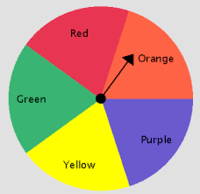
What is the complement of spinning purple on this spinner?
5.
MULTIPLE CHOICE QUESTION
1 min • 1 pt

Event A has a probability of 0.3. What is the probability of the complement of Event A?
6.
MULTIPLE CHOICE QUESTION
1 min • 1 pt
Given that the New Jersey Transit claims that its 8am train from Princeton to New York has a probability 0.9 of arriving on time. What does this probability mean in this setting
If chance behavior is predictable in the long term, then 10% of the trains are never late.
If you take a very large random sample of the 8am trains from Princeton to New York, about 90% of them will be on time.
90% of all the trains from Princeton to New York are on time.
90% of the time, the 8am trains from Princeton to New York are never late.
7.
MULTIPLE CHOICE QUESTION
1 min • 1 pt
The NJT claims that its 8am train from Princeton to New York has a probability 0.9 of arriving on time. The 8am train has arrived on time 5 days in a row. What's the probability that it will arrive on time tomorrow?
It will be on time tomorrow, since it's on time 90% of the time.
The probability of all trains from Princeton to New York is 90%, so this train will be on time. A single train on-time doesn't change the probability of all trains.
The probability that the 8am train from Princeton to New New is on time tomorrow is still 90%. Any short run of on-time trains does not change the probability that the next train will be on time.
The probability will change if the train is late, therefore the probability will either increase or decrease.
Access all questions and much more by creating a free account
Create resources
Host any resource
Get auto-graded reports

Continue with Google

Continue with Email

Continue with Classlink

Continue with Clever
or continue with

Microsoft
%20(1).png)
Apple

Others
Already have an account?


