
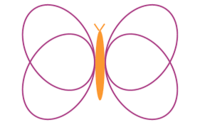
Symmetry

Flashcard
•
Mathematics
•
8th - 10th Grade
•
Practice Problem
•
Easy
+3
Standards-aligned

Wayground Content
Used 1+ times
FREE Resource
Student preview

15 questions
Show all answers
1.
FLASHCARD QUESTION
Front
What is symmetry in geometry?
Back
Symmetry in geometry refers to a situation where a shape or figure can be divided into parts that are arranged in a balanced and proportional manner. A figure is symmetric if it can be transformed into itself through certain operations such as reflection, rotation, or translation.
Tags
CCSS.4.G.A.3
2.
FLASHCARD QUESTION
Front
What is a line of symmetry?
Back
A line of symmetry is a line that divides a shape into two identical halves that are mirror images of each other. If a shape can be folded along this line, both halves will match perfectly.
Tags
CCSS.4.G.A.3
3.
FLASHCARD QUESTION
Front
What is the smallest angle of rotation that maps a figure onto itself?
Back
The smallest angle of rotation that maps a figure onto itself is known as the angle of rotational symmetry. It is the least angle through which a figure can be rotated to look the same as it did before the rotation.
Tags
CCSS.HSG.CO.A.4
4.
FLASHCARD QUESTION
Front
How do you determine the number of lines of symmetry in a shape?
Back
To determine the number of lines of symmetry in a shape, you can visually inspect the shape or use geometric methods to find all the lines that can divide the shape into two identical halves.
Tags
CCSS.4.G.A.3
5.
FLASHCARD QUESTION
Front
What is rotational symmetry?
Back
Rotational symmetry is a property of a shape that looks the same after a certain amount of rotation. A shape has rotational symmetry if it can be rotated around a central point and still appear unchanged.
Tags
CCSS.HSG.CO.A.4
6.
FLASHCARD QUESTION
Front
What is the angle of rotation for a shape with 5 lines of symmetry?
Back
The angle of rotation for a shape with 5 lines of symmetry is 360° divided by 5, which equals 72°.
Tags
CCSS.HSG.CO.A.4
7.
FLASHCARD QUESTION
Front
Can a figure have no lines of symmetry?
Back
Yes, a figure can have no lines of symmetry. An example is an irregular shape that does not have any line that can divide it into two identical halves.
Tags
CCSS.4.G.A.3
Access all questions and much more by creating a free account
Create resources
Host any resource
Get auto-graded reports

Continue with Google

Continue with Email

Continue with Classlink

Continue with Clever
or continue with

Microsoft
%20(1).png)
Apple

Others
Already have an account?



