
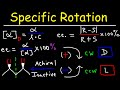
Optical Activity and Chiral Molecules

Interactive Video
•
Chemistry, Science
•
10th - 12th Grade
•
Practice Problem
•
Hard

Mia Campbell
FREE Resource
Read more
10 questions
Show all answers
1.
MULTIPLE CHOICE QUESTION
30 sec • 1 pt
What is the term used to describe a molecule that can rotate plane-polarized light?
Optically active
Symmetrical
Optically inactive
Achiral
2.
MULTIPLE CHOICE QUESTION
30 sec • 1 pt
Which of the following is true about enantiomers?
They have different solubilities.
They have identical optical properties.
They have different boiling points.
They are mirror images of each other.
3.
MULTIPLE CHOICE QUESTION
30 sec • 1 pt
What does the R/S configuration of a chiral center indicate?
The physical properties of the molecule
The direction of light rotation
The solubility of the molecule
The configuration at the chiral center
4.
MULTIPLE CHOICE QUESTION
30 sec • 1 pt
What happens to plane-polarized light when it passes through an achiral molecule?
It remains unchanged.
It rotates to the right.
It rotates to the left.
It is absorbed completely.
5.
MULTIPLE CHOICE QUESTION
30 sec • 1 pt
How is specific rotation calculated?
By dividing the observed rotation by the path length and concentration
By multiplying the observed rotation by the path length
By adding the observed rotation to the path length
By dividing the observed rotation by the concentration
6.
MULTIPLE CHOICE QUESTION
30 sec • 1 pt
What is the relationship between enantiomeric excess and optical purity?
Optical purity is twice the enantiomeric excess.
They are unrelated.
Enantiomeric excess is the square of optical purity.
They are equivalent in decimal form.
7.
MULTIPLE CHOICE QUESTION
30 sec • 1 pt
Which of the following is NOT a factor in determining specific rotation?
Temperature
Observed rotation
Path length
Concentration
Access all questions and much more by creating a free account
Create resources
Host any resource
Get auto-graded reports

Continue with Google

Continue with Email

Continue with Classlink

Continue with Clever
or continue with

Microsoft
%20(1).png)
Apple

Others
Already have an account?
Similar Resources on Wayground

6 questions
GCSE Secondary Maths Age 13-17 - Geometry & Measures: Translation - Explained
Interactive video
•
10th - 12th Grade
11 questions
SN1 and SN2 Reaction Mechanisms
Interactive video
•
10th - 12th Grade
11 questions
Angular Momentum and Torque Concepts
Interactive video
•
10th - 12th Grade
11 questions
Wave-Particle Duality of Light
Interactive video
•
10th - 12th Grade
8 questions
Sistemas de referencia y la relatividad de Galileo
Interactive video
•
11th Grade - University
8 questions
Alkenes & Alkynes - Crash Course Chemistry
Interactive video
•
11th Grade - University
6 questions
Exploring Earth, Sun, and Moon: Earth's Moon
Interactive video
•
10th - 12th Grade
6 questions
Surgical robot performing stitching on a dummy
Interactive video
•
10th - 12th Grade
Popular Resources on Wayground
8 questions
Spartan Way - Classroom Responsible

Quiz
•
9th - 12th Grade
15 questions
Fractions on a Number Line
Quiz
•
3rd Grade
14 questions
Boundaries & Healthy Relationships

Lesson
•
6th - 8th Grade
20 questions
Equivalent Fractions
Quiz
•
3rd Grade
3 questions
Integrity and Your Health
Lesson
•
6th - 8th Grade
25 questions
Multiplication Facts
Quiz
•
5th Grade
9 questions
FOREST Perception
Lesson
•
KG
20 questions
Main Idea and Details
Quiz
•
5th Grade
Discover more resources for Chemistry
22 questions
Unit 9 Gas Law Quiz
Quiz
•
10th Grade
20 questions
Types of Chemical Reactions
Quiz
•
9th - 12th Grade
13 questions
Solubility Curves
Quiz
•
10th Grade
20 questions
momentum and impulse
Quiz
•
9th - 12th Grade
22 questions
Solubility Curve Practice
Quiz
•
10th Grade
40 questions
Unit 3 (Part 1) Chemical Equations & Reactions Review Game
Quiz
•
8th - 12th Grade
20 questions
Naming Covalent Compounds
Quiz
•
11th Grade
35 questions
Types of Chemical Reactions
Quiz
•
9th - 12th Grade