
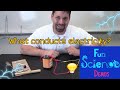
Understanding Conductors and Insulators

Interactive Video
•
Physics, Science, Fun
•
1st - 5th Grade
•
Practice Problem
•
Easy

Amelia Wright
Used 30+ times
FREE Resource
Read more
10 questions
Show all answers
1.
MULTIPLE CHOICE QUESTION
30 sec • 1 pt
What is the main idea discussed in the introduction of the video?
Electricity does not require conductors.
Electricity is always easy to conduct.
Electricity needs a path to follow.
Electricity can flow without a path.
2.
MULTIPLE CHOICE QUESTION
30 sec • 1 pt
What is used to demonstrate the flow of electricity in the video?
A fan
A battery
A light bulb
A motor
3.
MULTIPLE CHOICE QUESTION
30 sec • 1 pt
What happens when metal is connected to metal in the demonstration?
The light bulb does not light up.
The electricity stops flowing.
The light bulb lights up.
The wire melts.
4.
MULTIPLE CHOICE QUESTION
30 sec • 1 pt
What is the result when the metal part of the hammer is tested?
It breaks the circuit.
It does not affect the light bulb.
It is a conductor.
It is an insulator.
5.
MULTIPLE CHOICE QUESTION
30 sec • 1 pt
What is the conclusion about wood when tested with electricity?
Wood is an insulator.
Wood is a conductor.
Wood allows partial flow of electricity.
Wood enhances the flow of electricity.
6.
MULTIPLE CHOICE QUESTION
30 sec • 1 pt
What is observed when the metal part of the screwdriver is tested?
It does not conduct electricity.
It is an insulator.
It conducts electricity.
It breaks the circuit.
7.
MULTIPLE CHOICE QUESTION
30 sec • 1 pt
What is the result when plastic is tested for conductivity?
Plastic is a conductor.
Plastic is an insulator.
Plastic enhances electricity flow.
Plastic partially conducts electricity.
Access all questions and much more by creating a free account
Create resources
Host any resource
Get auto-graded reports

Continue with Google

Continue with Email

Continue with Classlink

Continue with Clever
or continue with

Microsoft
%20(1).png)
Apple

Others
Already have an account?


