
CIE IGCSE 8.3 Making soluble and insoluble salts
Authored by Claire Phillips
Chemistry
9th - 10th Grade
NGSS covered
Used 253+ times


AI Actions
Add similar questions
Adjust reading levels
Convert to real-world scenario
Translate activity
More...
Content View
Student View
11 questions
Show all answers
1.
MULTIPLE CHOICE QUESTION
1 min • 1 pt
What does the word insoluble mean?
Does dissolve
Doesn't dissolve
Is part of a solid
2.
MULTIPLE CHOICE QUESTION
1 min • 1 pt
What type of reaction produced an insoluble salt?
Neutralisation reaction
Precipitation reaction
Titration reaction
Insoluble reaction
3.
MULTIPLE CHOICE QUESTION
1 min • 1 pt
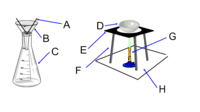
Identify the 'evaporating basin' from the diagrams.
4.
MULTIPLE CHOICE QUESTION
1 min • 1 pt
When a soluble salt is formed from an acid and an insoluble base, how do you know when an excess of a base has been added?
When bubbles of gas appear
When the reactant all dissolves
When some of the reactant is left unreacted/undissolved
When a colour change happens
Tags
NGSS.MS-PS1-2
5.
MULTIPLE CHOICE QUESTION
1 min • 1 pt
Why do you add excess of the insoluble reactant when making a soluble salt?
To make sure all the acid is used up
To separate the solid from the solution
To make sure a reaction occurs
To have the reaction happen faster
Tags
NGSS.MS-PS1-5
6.
MULTIPLE CHOICE QUESTION
1 min • 1 pt
How do you separate an excess insoluble reactant from a solution?
Filtration
Precipitation
Crystalisation
Evaporation
7.
MULTIPLE CHOICE QUESTION
1 min • 1 pt
When producing a soluble salt in a reaction between an acid and an alkali, how can you prepare dry solid crystals from the solution?
Filtration
Neutralisation
Condensation
Evaporation/crystallisation
Access all questions and much more by creating a free account
Create resources
Host any resource
Get auto-graded reports

Continue with Google

Continue with Email

Continue with Classlink

Continue with Clever
or continue with

Microsoft
%20(1).png)
Apple

Others
Already have an account?



